Custody Journal: What to Write and How to Keep Records
· By MyCourtDocs
A well-maintained custody journal can be powerful evidence. Learn what to include, what to avoid, and see examples of effective entries.
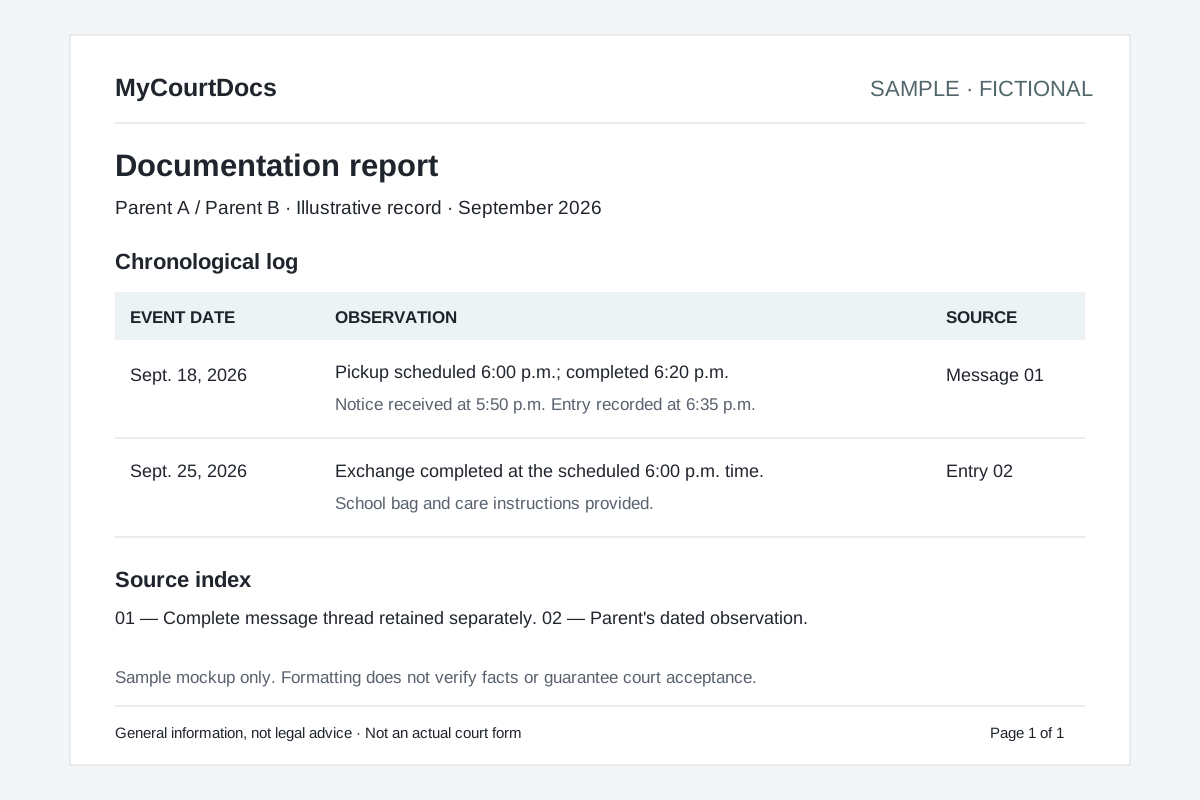
A custody journal is one of the most valuable tools you can use to build your case. This daily or weekly log of custody-related events becomes a powerful record when organized properly and maintained consistently.
Why Keep a Custody Journal?
Memory fades quickly, but a well-maintained journal preserves details that matter:
- Creates a contemporaneous record that courts find credible
- Helps you identify patterns you might otherwise miss
- Provides your attorney with detailed information
- Reduces stress by giving you an outlet for concerns
- Helps you prepare for depositions or testimony
What to Write in Your Custody Journal
Essential Information for Each Entry
- Date and time — Always include these first
- Who was present — Name everyone involved
- What happened — Factual description
- Direct quotes — Use quotation marks for exact words
- Child's condition or behavior — Observable facts only
- Evidence collected — Photos, screenshots, etc.
Example Journal Entry
Saturday, January 15, 2025 - 5:45 PM
Custody exchange at McDonald's parking lot on Main Street.
Other parent arrived at 5:45 PM (scheduled time was 5:00 PM). No explanation given for delay. Children (Emma, 8, and Jake, 6) were in the backseat.
Emma said: "Mom said we had to finish a movie first."
Jake appeared tired and was still in pajamas. Other parent handed over school backpack but no medication bag. I asked about Emma's allergy medication and was told: "I forgot it. I'll drop it off tomorrow."
Took photo of children's arrival condition (attached).
Categories of Events to Document
Custody Exchanges
- Arrival and departure times
- Location
- Children's condition upon arrival
- Items exchanged (medication, clothes, school supplies)
- Any communication with other parent
Communication Attempts
- Calls made and whether answered
- Video chat requests and outcomes
- Messages sent and responses received
- Communication blocks or restrictions
Children's Statements
- Spontaneous comments about the other home
- Questions children ask
- Concerns expressed
- Changes in behavior before or after visits
Schedule Changes
- Requests to modify schedule
- Makeup time offered or denied
- Last-minute cancellations
- Holiday or vacation conflicts
Medical and School Matters
- Doctor appointments and who attended
- School events and parent participation
- Educational decisions made
- Health issues or concerns
Writing Tips for Effective Entries
Write in Real Time
Document events within 24 hours while details are fresh. Delayed entries are less credible in court.
Be Specific
"Arrived 30 minutes late at 5:30 PM" is better than "Was late again as usual."
Stay Neutral
Avoid emotional language, name-calling, or speculation about the other parent's motives.
Include Positive Entries
Document smooth exchanges and cooperative moments too. A balanced journal appears more credible.
Quote Directly
Use exact quotes when possible: "He said, 'I'm not bringing them back early.'" is stronger than "He refused."
What NOT to Write
Avoid These Common Mistakes
- • Emotional venting — Keep your feelings separate; this is evidence, not therapy
- • Speculation — "I think he did this because..." isn't helpful
- • Insults or name-calling — Undermines your credibility
- • Exaggeration — Stick to exactly what happened
- • Coaching admissions — Never write about asking children leading questions
Digital vs. Paper Journals
Paper Journal
- ✓ Simple and familiar
- ✓ No technology required
- ✗ Can be lost or damaged
- ✗ Harder to organize and search
- ✗ No automatic timestamps
Digital/App Journal
- ✓ Automatic date/time stamps
- ✓ Easy to search and organize
- ✓ Attach photos and files
- ✓ Secure backup and sharing
- ✓ Court-ready exports
Creating a Documentation Routine
Consistency is key. Create a routine that works for your schedule:
- After every exchange: Take 5 minutes to document immediately
- Daily: Note any calls, messages, or concerns before bed
- Weekly: Review entries for completeness and accuracy
- Monthly: Identify any emerging patterns
Pro Tip
Set a daily phone reminder (e.g., 8:30 PM) to spend 5 minutes documenting the day. This small habit builds a powerful record over time.
How Long to Keep Your Journal
Keep your custody journal indefinitely—at least until your youngest child turns 18. Custody cases can be reopened years later, and historical documentation may become relevant for modification hearings.
Conclusion
A well-maintained custody journal is one of the most powerful tools in your documentation arsenal. By writing consistently, factually, and objectively, you create a contemporaneous record that courts find highly credible. Start today—even if you're not currently in court, the documentation you build now could be invaluable later.