How to Document Custody Schedule Violations for Court
· By MyCourtDocs
Schedule violations can demonstrate a pattern of behavior. Learn the right way to document each incident for maximum court impact.
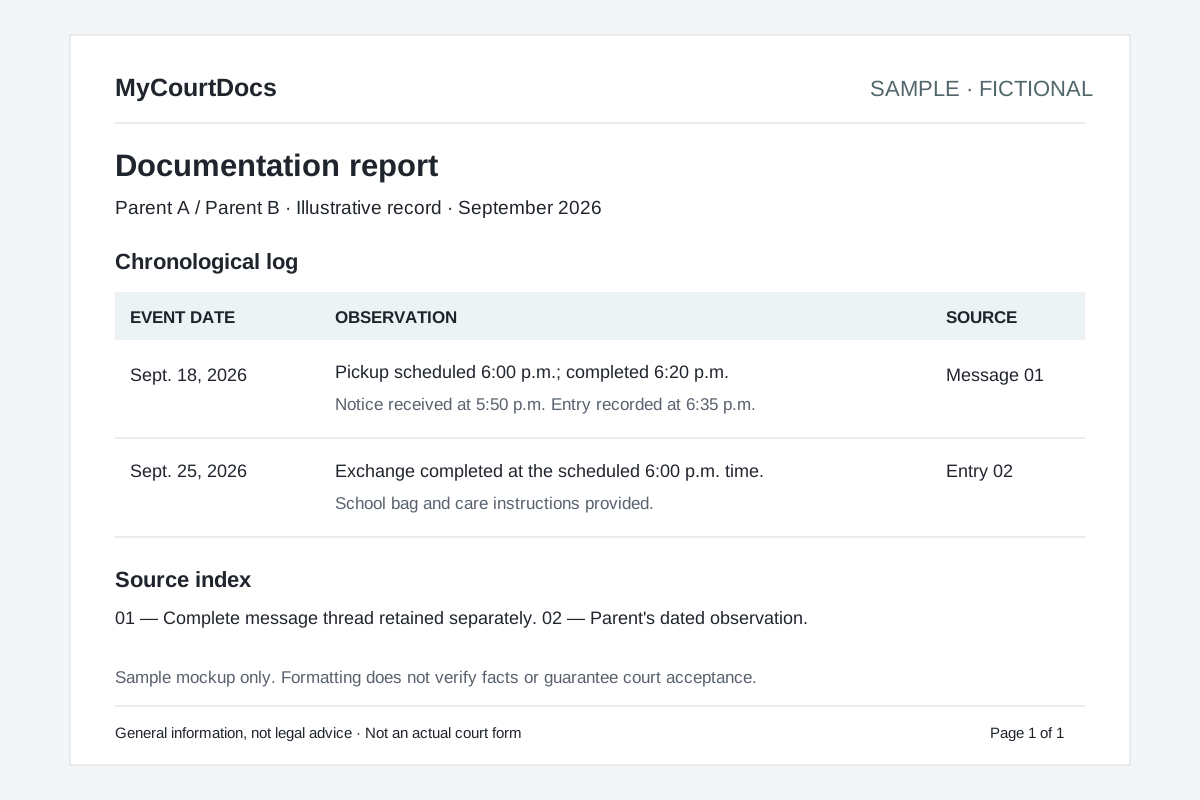
Custody schedule violations—late arrivals, early returns, no-shows, and denied visitation—are among the most common and frustrating issues in co-parenting. Proper documentation of these violations can be crucial for enforcement actions or custody modifications.
Types of Schedule Violations
Timing Violations
- Late drop-offs — Arriving after the scheduled exchange time
- Early returns — Bringing children back before parenting time ends
- Late pickups — Not arriving on time to receive children
- Extended time — Not returning children when parenting time ends
Denial Violations
- Complete refusal — Not allowing scheduled visitation at all
- Conditional denial — "You can see them if you..."
- Last-minute cancellation — Canceling without legitimate reason
- Interference — Scheduling activities during the other parent's time
Communication Violations
- No-show without notice — Simply not appearing
- Blocking communication — Preventing calls or video chats during parenting time
- Withholding information — Not sharing schedule changes or child updates
How to Document Each Violation
Essential Details to Record
- • Scheduled time: What the court order or agreement says
- • Actual time: What really happened
- • Duration: How late or how long the violation lasted
- • Reason given: What excuse (if any) was provided
- • Your response: What you said or did
- • Impact on children: Observable effects
Example Documentation Entry
Sunday, January 12, 2025
Court Order: Exchange at 6:00 PM, McDonald's parking lot (123 Main St)
Scheduled time: 6:00 PM drop-off
Actual arrival: 7:15 PM (1 hour 15 minutes late)
Communication: Text sent at 6:10 PM asking for ETA. Response at 6:45 PM: "Running late, traffic." (See screenshot attached)
Witness: My mother, Susan Smith, was present and observed the late arrival.
Child observation: Children appeared tired. Jake (age 6) had not eaten dinner. Emma (age 8) mentioned they left the other parent's house at 7:00 PM.
Building a Pattern Analysis
Individual violations may not seem significant, but patterns are powerful. Track violations systematically:
| Month | Scheduled Exchanges | On-Time | Late (>15 min) | Denied/Cancelled |
|---|---|---|---|---|
| October 2024 | 8 | 5 | 3 | 0 |
| November 2024 | 8 | 4 | 3 | 1 |
| December 2024 | 8 | 3 | 4 | 1 |
| Total | 24 | 12 (50%) | 10 (42%) | 2 (8%) |
Evidence to Collect
Timestamped Communication
Screenshots of texts asking "Where are you?" and responses (or lack thereof).
Location Evidence
Photo of your car at the exchange location showing timestamp metadata.
Witness Statements
Have someone with you at exchanges who can verify timing.
Calendar Documentation
Maintain a detailed calendar showing scheduled vs. actual exchanges.
What to Do When a Violation Occurs
- Stay calm — Don't react emotionally; focus on documentation
- Send a timestamped message — "It's 6:15 PM. You were scheduled to arrive at 6:00. Please update me on your ETA."
- Wait a reasonable time — Courts expect you to show patience (15-30 minutes for minor delays)
- Document everything — Take photos, save messages, note times
- Follow up in writing — Send a summary email after: "Today's exchange was scheduled for 6:00 PM. You arrived at 7:15 PM..."
Pro Tip: The Follow-Up Email
After every problematic exchange, send a polite summary email. This creates a contemporaneous record and gives the other parent a chance to dispute your account. Their silence or response becomes additional evidence.
When to Take Action
Document first, then consult with your attorney about enforcement options:
- Motion for contempt — When the other parent repeatedly violates court orders
- Modification request — When violations show a pattern that harms children
- Make-up time request — For denied or significantly shortened parenting time
Don't Self-Help
Never withhold your own parenting time as "payback" for the other parent's violations. Two wrongs don't make a right, and you'll lose credibility in court. Document their violations and follow proper legal channels.
Technology Tools for Tracking
Using a dedicated custody documentation app makes tracking violations much easier:
- Automatic timestamps — No question about when you documented
- Pattern reports — See violation trends at a glance
- Evidence linking — Attach photos and screenshots directly to entries
- Calendar integration — Compare scheduled vs. actual exchanges
- Court-ready exports — Generate professional summaries
Conclusion
Consistent, detailed documentation of schedule violations builds a powerful case for enforcement or modification. Focus on facts, collect supporting evidence, and let the pattern speak for itself. When you can show a judge a clear record of repeated violations, you have the foundation for effective legal action.