Documenting Refusal to Share School or Medical Records in Custody
· By MyCourtDocs
When a co-parent withholds school reports or medical records, clear documentation is vital. Learn how to track requests, access direct records, and build court-ready proof.
When parents share legal custody, both typically retain the right to stay informed about their child's health and education. However, disputes often arise when one parent stops passing along report cards, fails to disclose doctor appointments, or removes the other parent from emergency contact lists.
Dealing with a co-parent withholding school info or medical updates can feel frustrating and isolating. When addressing these issues in family court, vague claims of being "left out of the loop" rarely carry weight. Judges look for factual, contemporaneous evidence showing specific requests, direct provider outreach, and patterns of non-disclosure. Learning how to properly document information sharing failures allows you to present a clear, neutral record if legal intervention becomes necessary.
Understand Your Legal Rights to School and Medical Records
Legal custody generally refers to the authority to make major life decisions for a child, including matters involving education, non-emergency medical care, and religious upbringing. In most jurisdictions, joint legal custody orders explicitly grant both parents equal access to educational and medical records, regardless of the physical parenting schedule.
Even when custody orders are contested or silent on specific sharing duties, federal and state laws often protect your direct access:
- Educational records: Under the Family Educational Rights and Privacy Act (FERPA), schools must generally provide biological or legal parents access to official academic records, attendance logs, and disciplinary files unless a court order explicitly terminates those parental rights.
- Medical records: Under the Health Insurance Portability and Accountability Act (HIPAA) Privacy Rule, a legal parent or personal representative usually holds the right to review and obtain copies of the child's protected health records, subject to specific state exceptions (such as adolescent mental health or reproductive care).
Because state statutes and local court rules vary widely, review your existing custody decree or consult a licensed family law attorney to verify your exact legal standing. If you suspect an intentional pattern of omission, understanding how to capture school & medical communications for a custody case ensures you start collecting records through proper legal and administrative channels.
Concrete Steps to Document Withheld Information
To show a court that information is being withheld, you must prove two things: that the information existed, and that you made reasonable, documented efforts to obtain it. Courts look unfavorably on accusations when a parent made no effort to check an online parent portal or contact the provider directly.
Establish a clear, step-by-step workflow whenever you discover that information was concealed or omitted:
1. Document the Discovery
Write down exactly when and how you discovered the missing information. For example, note if your child mentioned visiting an urgent care clinic over the weekend, or if a teacher casually referenced a parent-teacher conference that occurred without your knowledge. Record the date, time, and source of discovery immediately.
2. Check Primary Direct Sources
Before confronting your co-parent, verify whether the information was accessible directly. Check your school's online grading platform, the pediatric patient portal, or provider email blasts. If your login was disabled or your contact details were removed, take timestamped screenshots showing that your access was revoked or omitted.
3. Send a Written, Business-Like Inquiry
Reach out to the other parent using a trackable communication method, such as a co-parenting application or email. Keep the message factual, neutral, and focused entirely on the child's needs:
- Neutral example: "Our child mentioned seeing Dr. Smith yesterday for an earache. Please share the diagnosis, prescribed treatment, and any follow-up appointments scheduled so I can maintain continuity during my parenting time."
- Avoid emotional language: "Why are you keeping secrets from me? You are violating our court order by taking our child to the doctor behind my back."
4. Record the Response (or Lack of Response)
Give the other parent a reasonable window to respond, typically 24 to 48 hours for routine matters, or immediately for acute medical issues. If they refuse to provide details or fail to respond entirely, export and archive the message thread.
When you organize your parenting records systematically, learning how to document custody for court helps ensure these communications are preserved with verifiable timestamps, unedited message logs, and clear chronological context.
Managing Direct Outreach to Schools and Healthcare Providers
Family court judges expect parents to exercise reasonable initiative. If the other parent refuses to forward school notices or medical summaries, you should actively establish independent relationships with the professionals serving your child.
Take proactive steps with every school and medical office:
- Provide certified copies of your court order: Deliver a copy of your current custody order to the school registrar, principal, pediatrician, and any specialized therapists. Highlight sections confirming joint legal custody or direct records access.
- Request separate contact listings: Ask staff to list both parents independently on file, with separate email addresses, phone numbers, and physical mailing addresses. Ensure you are listed on emergency contact cards.
- Sign up for separate portal accounts: Request your own unique login credentials for school learning management systems (such as Canvas or Google Classroom) and medical patient portals (such as Epic MyChart).
- Request written confirmation if access is denied: If a provider states that the other parent instructed them not to speak with you, remain calm. Politely ask the staff member to put that policy in writing or provide a copy of any documentation submitted by the other parent requesting your exclusion.
Keeping a log of your direct interactions with providers prevents the other parent from claiming you showed no interest in the child's day-to-day welfare. If you are experiencing conflict over care providers, reviewing how to document medical decision disagreements in custody cases can provide additional structure for tracking provider-level disputes.
Maintaining a Factual Incident Log
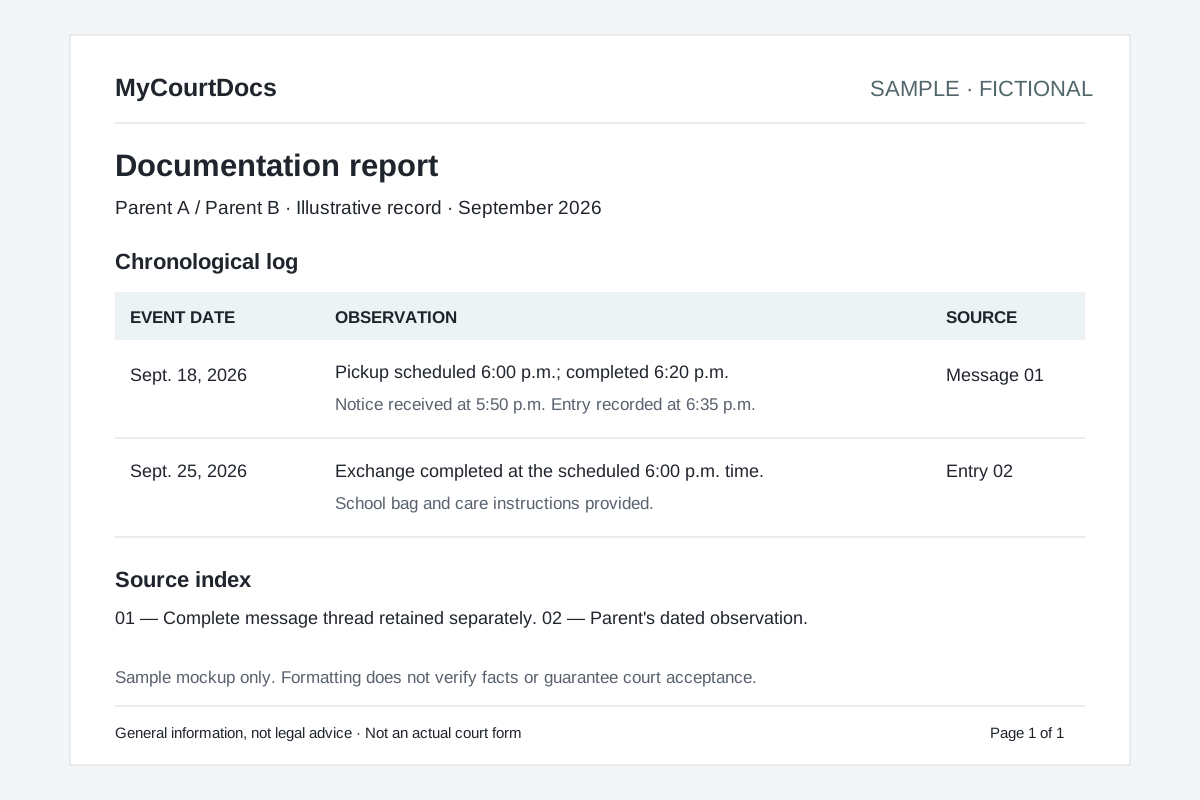
When presenting documentation to an attorney or judge, a clean, organized log is far more effective than hundreds of disjointed text messages. An incident log translates chaotic daily disputes into clear, quantifiable data.
Your incident log should track objective facts rather than personal interpretations. For each incident involving medical records access custody issues or withheld educational updates, record:
- Date and Time: When the event occurred or when you learned of it.
- Category: Educational (e.g., IEP meeting, report card, disciplinary action) or Medical (e.g., doctor visit, prescription change, therapy appointment).
- Event Details: A brief, neutral description of the underlying event (e.g., "Child attended annual dental cleaning with co-parent").
- Your Action: The exact date and method of your inquiry (e.g., "Sent request via co-parenting app asking for dental summary and follow-up recommendations").
- The Outcome: The other parent's response, non-response, or direct provider confirmation (e.g., "No response received within 72 hours. Contacted dental office directly on Friday; obtained invoice showing two cavities requiring filling").
- Attached Exhibits: Reference numbers for corresponding PDF records, portal screenshots, or message exports.
For ongoing specialized care, such as counseling or behavioral treatment, specialized tracking may be required. You can see how this works in practice by reading our guide on child therapy attendance: how to document for custody.
How Courts Evaluate Information Withholding
Family courts focus primarily on the best interests of the child. When evaluating claims that a parent is withholding school or medical information, judges look at whether the behavior impairs the child's well-being or undermines the legal custody framework.
Courts generally assess:
- Patterns vs. Isolated Mistakes: Forgetting to forward a single school newsletter about picture day is viewed differently than a systematic pattern of scheduling surgeries, switching pediatricians, or changing schools without notice.
- Impact on the Child: Did the lack of information lead to missed doses of medication, inconsistent academic support, or unexcused school absences?
- Interference with Parental Rights: Did the parent intentionally remove the other parent from emergency contacts or misrepresent legal custody terms to third-party providers?
- Willingness to Support the Child's Relationship with Both Parents: In many states, custody statutes require courts to evaluate which parent is more likely to facilitate frequent and continuing contact and encourage a close relationship between the child and the other parent.
Presenting a clear, fact-based record compiled over months allows your legal counsel to demonstrate a persistent pattern of behavior. By keeping your communications polite, exercising your direct statutory rights, and recording every event objectively, you position yourself effectively to protect your role in your child's life.
This article is for informational purposes only and is not legal advice. Consult a licensed attorney in your jurisdiction.
Frequently Asked Questions
Can a school refuse to give me records if my co-parent tells them not to?
Under FERPA, public schools must generally provide educational records to both biological or legal parents unless a valid court order specifically revokes those rights. Provide the school with a certified copy of your custody order and request independent portal credentials.
What should I do if my co-parent takes our child to the doctor without telling me?
Send a polite, written message via your standard co-parenting app or email requesting the diagnosis, treatment plan, and future appointments. Then, contact the provider directly with your custody paperwork to request a copy of the visit summary.
How do I prove my co-parent is intentionally withholding information?
Courts look for patterns over time rather than isolated oversights. Keep an objective incident log noting each missing update, your written request for details, and the resulting response or lack thereof.
Does HIPAA prevent me from seeing my child's medical records?
HIPAA allows parents acting as personal representatives to access their minor child's medical records, subject to specific state laws regarding sensitive adolescent care. Present your custody decree directly to the healthcare provider's records department.