How to Document a Pattern of Late Pickups for Child Custody
· By MyCourtDocs
Tired of waiting curbside? Learn how to document a chronic late pickup pattern with an objective exchange time log, verifiable timestamps, and clean communication records.
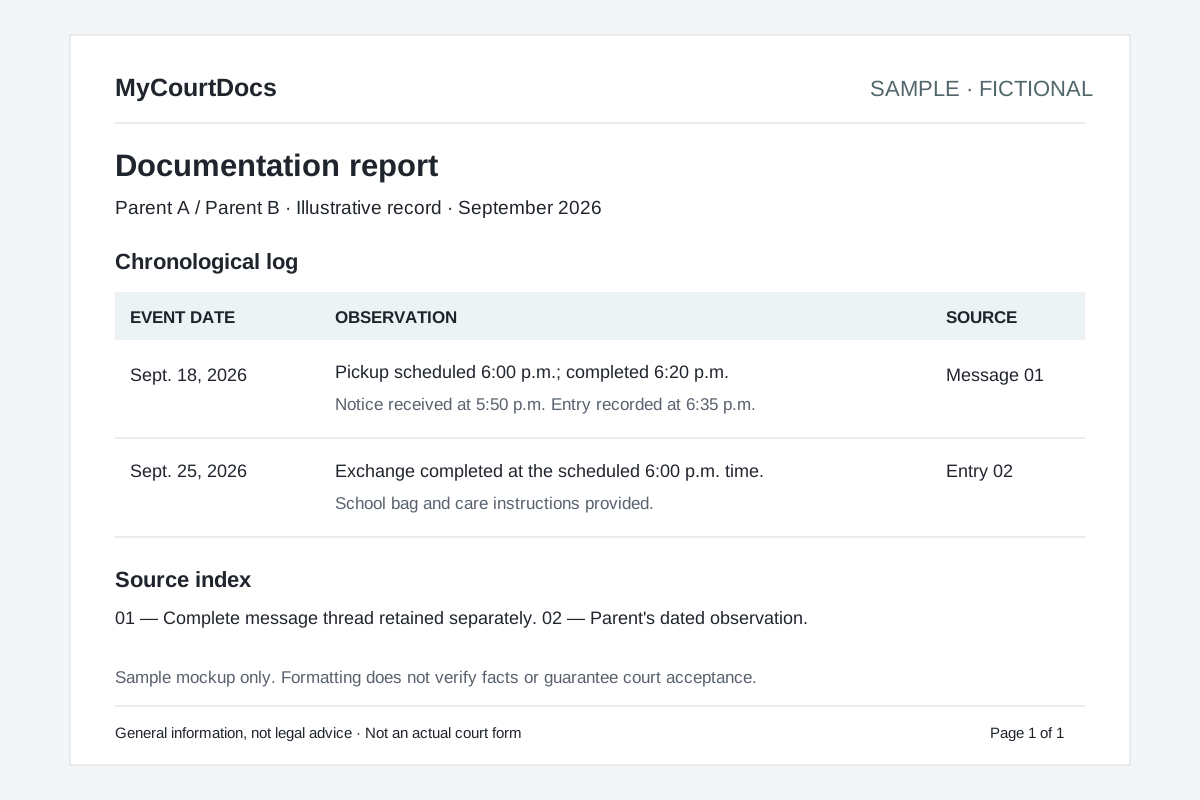
Waiting curbside or sitting in a parking lot with an anxious child is one of the most frustrating experiences in shared parenting. When an exchange is scheduled for 5:00 PM and the other parent consistently arrives at 5:45 PM, evening routines fall apart, dinner runs late, and bedtime becomes stressful.
An isolated delay caused by unexpected highway traffic or a flat tire is normal and generally understood by family courts. However, chronic lateness custody issues occur when tardiness shifts from an occasional mishap into an ongoing, predictable routine.
To family courts, a single late pickup is rarely actionable on its own. What matters is whether you can demonstrate a persistent, documented late pickup pattern that impacts the child's daily stability or violates the clear terms of your parenting agreement. Learning how to maintain an accurate exchange time log allows you to present objective facts rather than emotional accusations if you ever need to request a schedule modification or court intervention.
Why Isolated Delays Differ from a Chronic Late Pickup Pattern
In family law proceedings, judges expect co-parents to grant each other reasonable grace for everyday complications. Inclement weather, public transit delays, or minor work emergencies happen to everyone. When a parent files an urgent motion because the other parent was twenty minutes late twice in six months, courts often view that reaction as high-conflict or inflexible.
Chronic lateness, by contrast, involves repeated, sustained deviations from the court-ordered exchange schedule. It signals that one parent consistently treats the custody schedule as optional. Over weeks and months, repeated delays can force children to miss extracurricular practices, skip medical appointments, or endure hours of uncertainty.
When you prepare to present this issue to attorneys or a judge, you must establish that the behavior is systematic. Understanding how to prove a pattern of behavior in a custody case requires shifting your focus away from individual grievances and toward aggregated data. A well-kept log demonstrates frequency, average duration of delay, and the tangible effect on the child.
Courts primarily assess whether a parent's chronic lateness interferes with the child's best interests. If tardiness causes a child to regularly arrive late to school or miss scheduled tutoring, judges are far more likely to consider adjustments to exchange locations, transportation responsibilities, or drop-off windows.
What to Record in an Exchange Time Log
An effective exchange time log does not contain emotional venting, sarcasm, or assumptions about why the other parent is late. Instead, it serves as a business-like ledger that records objective data points in chronological order.
Whenever an exchange is scheduled, note the exact specifics contemporaneously—meaning at the moment the event happens or shortly thereafter. Writing down details weeks later from memory diminishes your credibility.
Essential Data Fields to Track
Every entry in your custody exchange record should capture basic, verifiable facts:
- Scheduled exchange details: The exact date, scheduled time, and agreed-upon exchange location specified in your custody order.
- Your arrival time: The time you arrived with the child at the designated exchange spot.
- Other parent's arrival time: The exact minute the other parent pulled up or walked into the exchange zone.
- Advance notice received: Did the co-parent send a message informing you of a delay? Note the timestamp of that message and how much advance notice it provided.
- Stated reason for delay: Record only what the other parent said (e.g., "Parent stated they got stuck on a work phone call"). Do not guess or speculate on other motives.
- Impact on the child: Note any missed commitments, such as missed sports games, delayed dinner, or late school arrival.
Sample Exchange Log Entry
Reviewing a concrete example helps clarify what family courts look for in real-world documentation:
- Date: October 12, 2025
- Scheduled Time: 5:00 PM
- Location: Public Library Parking Lot (Main St.)
- My Arrival Time: 4:55 PM
- Other Parent Arrival Time: 5:48 PM (48 minutes late)
- Notice Provided: Text message sent at 5:12 PM stating, "Running behind, be there soon." (Notice arrived 12 minutes after scheduled exchange time).
- Direct Impact: Child missed 5:30 PM community soccer practice; arrived at soccer field at 6:05 PM after practice concluded.
- Objective Notes: Remained in vehicle with child. Handed over soccer bag and equipment upon parent's arrival.
When you regularly collect entries structured like this, you create an evidentiary trail that speaks for itself without relying on dramatic language.
Concrete Supporting Evidence to Correlate with Your Log
A written journal entry is a great starting point, but courts find documentation significantly more persuasive when supported by independent, verifiable records. Combining your log with digital timestamps creates a clear, undeniable timeline.
Digital Communication and Messaging Apps
Save all written communication regarding exchanges. Whether you communicate via SMS, email, or a court-approved parenting application, keep exports of messages that show when notifications were sent.
Frequently, a chronically late parent will send messages such as "Leaving work now" twenty minutes after the exchange was supposed to take place. If you are dealing with frequent disruptions, learning the rules for documenting last-minute schedule change requests for custody ensures you capture both schedule modifications and running-late texts in a consistent format.
Location Data and Time-Stamped Receipts
If you conduct exchanges at public locations, you can easily verify your physical presence and arrival time:
- Merchant receipts: Purchase a water bottle, coffee, or pack of gum at a nearby business inside or adjacent to the exchange location. Keep the paper or digital receipt, which displays an exact timestamp and merchant address.
- GPS or location-stamped photos: Taking a quick photo of your dashboard clock or the location sign on your smartphone creates metadata (EXIF data) embedded with the exact date, time, and GPS coordinates.
- Dashcam footage: If your vehicle is equipped with a dashcam, save clips showing your vehicle parking at the exchange site and the co-parent arriving later.
To present this material clearly during mediation or court hearings, consider how you organize your records into your exhibits. When building a court binder: what to include and leave out, pair each log entry with its corresponding receipt or message screenshot so your legal counsel can present facts quickly.
How to Respond in the Moment Without Damaging Your Case
When you have been waiting twenty or thirty minutes past the scheduled time, it is entirely natural to feel angry. However, your in-person and digital reactions will be scrutinized just as closely as the other parent's tardiness. Losing your temper curbside or sending dozens of hostile text messages shifts the focus away from the other parent's chronic lateness and onto your communication style.
Keep all written communication calm, concise, and focused purely on logistics. If the other parent has not arrived ten to fifteen minutes after the scheduled exchange time, send a brief status check:
"Hi [Name], we arrived at the library at 4:55 PM for our 5:00 PM exchange. Please let me know your estimated arrival time so I can plan the child's schedule accordingly."
If the delay becomes significant—for instance, thirty to forty-five minutes with no communication—send an update establishing your next steps:
"It is now 5:45 PM and we have not heard from you. I am taking [Child] home so they can eat dinner and complete their homework. Please let me know when you are available to pick them up from the house."
Avoid using passive-aggressive language, making threats about court, or lecturing the other parent about responsibility. Never involve the child in the dispute by asking them to call the other parent to complain, expressing disgust about the other parent's tardiness within earshot, or asking the child to take sides. A judge evaluates which parent demonstrates emotional maturity and protects the child from adult conflict.
Thresholds: When Does Lateness Warrant Court Intervention?
Parents frequently ask how late is "too late" before a judge will take action. Family court statutes rarely define a strict, universal minute threshold for custody violations. Standards vary significantly by jurisdiction, county, and individual judicial discretion.
However, attorneys and family courts generally evaluate tardiness across three specific criteria:
- Predictability and frequency: Is the other parent late to more than half of all scheduled exchanges over a multi-month period?
- Magnitude of the delay: Are the delays minor (5–10 minutes) or substantial (30–90 minutes each time)?
- Harm to the child's routine: Does the tardiness cause the child to miss school, therapy, medical care, or sleep, or does it leave the child waiting unattended?
If an exchange order contains a specific grace period (such as a clause stating that if a parent is more than thirty minutes late without notice, the visitation is forfeited for that day), document adherence to that explicit provision. When chronic lateness creates substantial disruption, parents often consult legal counsel to request remedies such as:
- Adjusting pickup times to better match actual work schedules.
- Transferring transportation duties to the parent who is consistently waiting.
- Moving exchanges directly to school or daycare dismissal to eliminate direct parent-to-parent waiting periods.
- Designating specific alternative exchange protocols when delays exceed defined thresholds.
When preparing documentation for an attorney or court evaluator, you need a structured format that summarizes weeks of delays clearly. You can learn how to document custody for court so that your calendar, message history, and timestamps convert into an organized record that judicial professionals can digest in seconds.
Keep your records detailed, maintain professional communication at every exchange, and let clean data demonstrate the reality of your shared parenting routine.
This article is for informational purposes only and is not legal advice. Consult a licensed attorney in your jurisdiction.
Frequently Asked Questions
How late does a co-parent have to be for court to care?
Most family courts do not consider occasional delays of 5 to 15 minutes actionable unless they happen at nearly every exchange. However, if minor delays occur continuously over several months and disrupt school or extracurriculars, they can demonstrate a chronic pattern when recorded consistently.
How long should I wait at an exchange location before leaving?
Check your custody agreement first to see if it includes a specific grace period (often 20 to 30 minutes). If your agreement does not specify, send a calm message after 15 minutes asking for an ETA. If 30 to 45 minutes pass with no response, send a polite message stating you are returning home with the child, and log the incident.
Should I film the other parent arriving late?
No. Recording audio or video during an exchange can escalate tension and may violate state wiretapping or consent laws depending on where you live. A better approach is using objective records like time-stamped store receipts, GPS check-ins, dashcam footage showing arrival times, and text message exports.
What should I say in text messages when the other parent is late?
Keep messages purely factual, neutral, and brief. State your arrival time, note the current time, and ask for an estimated arrival time. Avoid accusations, emotional commentary, or threats of legal action, as these messages may be submitted to court as evidence of communication styles.