How to Document Parental Alienation: Evidence & Patterns
· By MyCourtDocs
Documenting parental alienation requires careful, objective record-keeping. Learn what patterns courts recognize and how to document them properly.
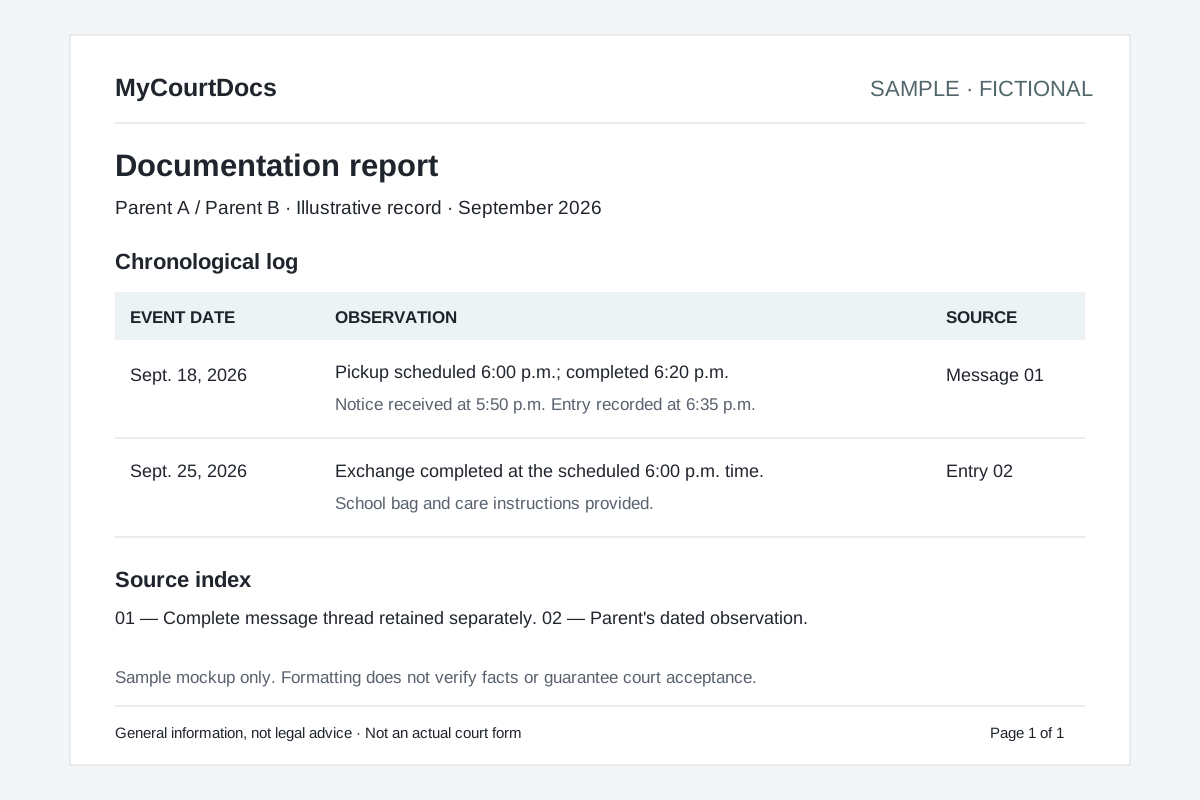
Parental alienation—when one parent attempts to damage the child's relationship with the other parent—is one of the most challenging dynamics to prove in family court. Proper documentation is essential, but it must be done carefully and objectively to be effective.
Important Disclaimer
Parental alienation is a complex issue that should be addressed with the help of qualified professionals—including attorneys and mental health experts. This article provides documentation guidance only and is not legal or psychological advice.
What Courts Look For
Family courts don't accept accusations of parental alienation at face value. Judges look for documented patterns of behavior that demonstrate interference with the parent-child relationship. Your documentation should focus on observable behaviors, not interpretations or diagnoses.
Behaviors to Document
Interference with Communication
- Phone calls that go unanswered or are cut short
- Video calls that are "forgotten" or have technical issues
- Messages that aren't passed along to children
- Changes to children's phone numbers or accounts
Schedule Violations
- Refusing to allow scheduled visitation
- Scheduling activities during your parenting time without consent
- Making last-minute excuses to deny custody time
- Not having children ready for exchanges
Negative Statements
- Disparaging remarks made within children's hearing
- Written communications containing negative statements
- Social media posts that undermine you
- Statements reported by children (document carefully—see below)
Exclusion from Decision-Making
- Medical decisions made without consultation
- School enrollment changes without notice
- Not being informed about activities or events
- Being excluded from parent-teacher conferences
How to Document Effectively
Document Facts, Not Feelings
Write "Child said 'Mom told me you don't love us'" rather than "Other parent is turning children against me."
Quote Exact Words
When documenting what children or the other parent said, use direct quotes. Include context about when and where the statement was made.
Record Attempts and Responses
Log every attempt to communicate and whether it was successful. Screenshot evidence of unanswered calls or messages.
Note Pattern Development
Track incidents over time to identify patterns. A single missed call isn't evidence, but 50 unanswered calls over 3 months shows a pattern.
Documenting What Children Say
Be very careful when documenting statements from children. Record exactly what they said, when they said it, and the context—but never probe or ask leading questions. Courts are skeptical of coached-sounding statements, so your documentation should reflect spontaneous comments, not interviews.
Evidence Types to Collect
Communication Records
- Call logs showing unanswered attempts
- Text messages with no response
- Emails requesting communication that were ignored
- Co-parenting app message history
Calendar Evidence
- Detailed log of scheduled vs. actual parenting time
- Evidence of activities scheduled during your time
- Records of makeup time offered but denied
Third-Party Documentation
- School records showing which parent is listed as contact
- Medical records showing who attends appointments
- Communications from teachers or coaches
- Statements from therapists (if permitted)
What NOT to Do
Avoid These Documentation Mistakes
- • Don't interrogate children — Never ask leading questions or probe for information
- • Don't use diagnostic terms — Leave "parental alienation syndrome" and similar labels to experts
- • Don't make accusations in front of children — Keep adult issues away from them
- • Don't respond with similar behavior — Take the high road and document, don't retaliate
- • Don't record without consent — Know your state's laws about recording conversations
Building Your Case
Proving parental alienation requires demonstrating a clear pattern over time. Your documentation should show:
- Frequency — How often do concerning behaviors occur?
- Pattern — Is there a consistent type of interference?
- Impact — How has the relationship with your child changed?
- Your response — What have you done to address the situation?
- Professional involvement — Have you sought help from therapists or mediators?
Working with Professionals
Your documentation becomes most powerful when combined with professional assessments:
- Child psychologist or therapist — Can evaluate the parent-child relationship
- Custody evaluator — Court-appointed expert to assess the situation
- Guardian ad litem — Attorney appointed to represent children's interests
- Family law attorney — Can advise on what evidence is most relevant
Conclusion
Documenting potential parental alienation is emotionally difficult, but systematic, objective records can make a significant difference in court. Focus on observable behaviors, maintain consistent documentation, and work closely with legal and mental health professionals. Your goal is to create a clear, factual record that speaks for itself.