What to Do When the Other Parent Ignores the Parenting Plan
· By MyCourtDocs
When a co-parent disregards your custody schedule, reacting out of anger can hurt your case. Learn how to document violations calmly and build clean enforcement evidence.
When a co-parent disregards a signed custody schedule, it creates immediate stress for your household and your children. Whether the issue involves chronic late arrivals at custody exchanges, missed weekends, or unilateral decisions regarding extracurricular activities, having a parenting plan not followed disrupts stability.
In these moments, frustration is natural. However, reacting out of anger can weaken your legal position if you eventually need to seek relief from a judge. Knowing how to handle custody order violations calmly, methodically, and with proper enforcement evidence ensures your children’s routines are protected while preserving your credibility in court.
Review Your Order and Assess the Violation
Before taking formal action, carefully reread your current court order, custody agreement, or decree. While a schedule might seem clear in daily memory, legal language often contains specific nuances, grace periods, or notice requirements that dictate how non-compliance is defined.
Ask yourself whether the behavior constitutes an occasional disruption or a persistent pattern:
- Isolated incidents: A flat tire, severe traffic, or an unexpected illness that delays an exchange by twenty minutes is usually viewed by courts as an unavoidable reality of daily life. While frustrating, a single minor delay rarely warrants court intervention.
- Systematic non-compliance: Repeatedly withholding parenting time, arriving hours late without notice every weekend, refusing to return the child, or making major medical or educational decisions without consultation violates the structure of joint custody.
Examine the exact wording of your agreement. Does your decree specify a fifteen-minute grace period for drop-offs? Does it require 48 hours of written notice before altering a weekend schedule? If your agreement lacks clear structure, you may find our guide on how to structure a custody agreement with a parenting plan template helpful for understanding standard provisions and defining obligations.
Understanding whether the other parent’s actions directly breach a clear, unambiguous clause helps you determine your next steps. If the language in the order is vague, courts often encourage parents to clarify or modify terms rather than issue sanctions for contempt.
Maintain Professional, Direct Communication
When an order is disregarded, your immediate communications establish the factual record. Judges frequently review text messages, portal communications, and emails to evaluate how both parties handled the conflict. Emotional outbursts, sarcastic remarks, or threats can undermine your position, even if the other parent was completely in the wrong.
Keep your written communications brief, factual, and focused entirely on the child's schedule:
- State the expectation: Reference the specific schedule laid out in your agreement (e.g., "Our court order states Friday exchange is at 5:00 PM at the community library").
- State the current status: Note the current time and situation neutrally (e.g., "It is currently 5:30 PM. I am waiting at the designated location with the children").
- Ask for confirmation: Request a concrete update (e.g., "Please let me know if you are on your way and your estimated arrival time").
Avoid lecturing, debating past grievances, or assigning labels to the other parent's character. If you receive an antagonistic or dismissive response, do not engage in an argument. Simply reiterate the schedule and confirm the facts. Keeping your words strictly child-focused creates written proof that you attempted to facilitate the schedule cooperatively and complied with your side of the court order.
Collect Clean, Objective Enforcement Evidence
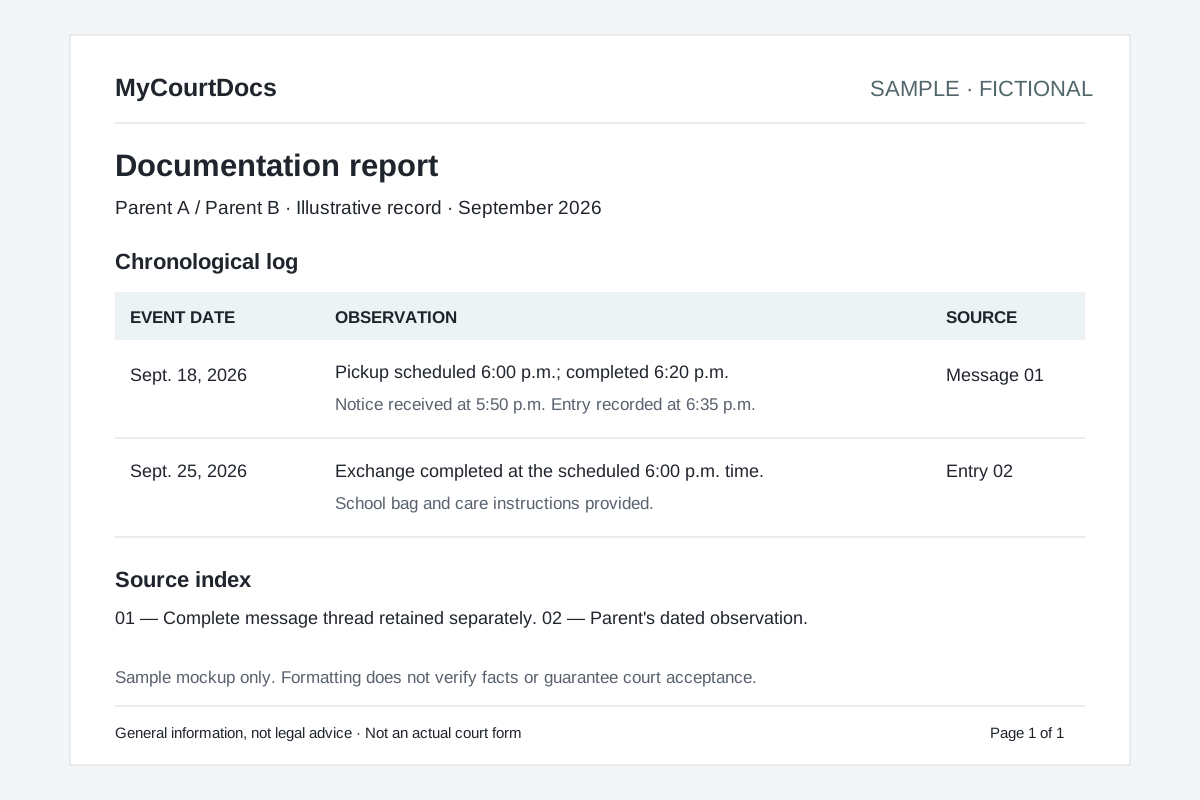
Courts operate on verifiable facts rather than personal recollections. If you must return to court to ask a judge to enforce your schedule, having organized, contemporaneous records is critical. To build persuasive enforcement evidence, you need to document what happened at the exact time it occurred.
Every documented incident should include specific, observable details:
- Date, exact timestamp, and location: Record precisely when an event occurred, when you arrived, and how long you waited.
- Factual summary of behavior: Write down what occurred without emotional language or subjective interpretations. Record statements made verbatim rather than summarizing them with assumptions.
- Corroborating documentation: Save text messages, written portal logs, GPS location stamps, calendar notifications, or receipts from nearby businesses that confirm your presence.
- Neutral witnesses: Note if a teacher, daycare director, or neutral third party observed the missed exchange. You can read our detailed guide on how to log third-party witnesses for custody events to ensure their contact details and observations are stored effectively.
Many parents wonder how to quietly track these details without escalating conflict at the exchange site. Learning how to document custody without the other parent knowing allows you to maintain a thorough, low-conflict log that protects your privacy while building a clean record.
When you present these records, organization is essential. If you want to learn how to compile logs, messages, and receipts into a format that attorneys and judicial officers can easily read, explore how to document custody for court using systematic, contemporaneous entries.
When to Involve Law Enforcement or Neutral Third Parties
A common dilemma for parents dealing with missed exchanges or withheld parenting time is whether to call the police. The appropriateness of law enforcement involvement depends heavily on the circumstances and local jurisdiction rules.
In most family law situations, law enforcement officers will view custody disputes as civil matters. Unless there is an immediate safety concern, a protective order violation, or an explicit criminal statute regarding custodial interference, officers will rarely physically enforce an exchange or force a child into a vehicle. Instead, they may review the paperwork and write an informational incident report noting that a dispute occurred.
Before requesting a police dispatch or a "civil standby," consider the emotional impact on your children:
- Child welfare first: Having police cars arrive at an exchange can be deeply distressing for a child and may heighten their anxiety around transitions.
- Obtaining neutral documentation: If an exchange takes place at a police station lobby or public facility, an officer or clerk can sometimes confirm arrival times without creating a scene.
- Incident numbers: If officers do arrive, always write down the responding officers' names, badge numbers, and the administrative incident or report number so your attorney can subpoena or request the record later.
Because municipal and state policies regarding police intervention in custody disputes vary widely, consult with a local family law attorney before deciding whether to involve law enforcement for routine non-compliance.
Legal Remedies: Contempt, Enforcement, and Modification
When informal resolution fails and violations continue, you may need to pursue formal legal relief through the family court system. Understanding the available legal mechanisms helps you and your attorney choose the right strategy for your situation.
Family courts generally offer three primary paths to address non-compliance:
1. Motion for Enforcement
A motion for enforcement requests that the court order the non-compliant parent to follow the existing decree. In many jurisdictions, the court may also order "make-up parenting time" to compensate for lost days and award attorney fees to the parent who was forced to bring the motion.
2. Motion for Contempt of Court
Contempt proceedings are punitive and require proving that the other parent had the ability to follow a clear, valid order and willfully chose to violate it. Because contempt can carry penalties such as fines or, in extreme cases, brief incarceration, the evidentiary standard is high. You must demonstrate that the violation was willful and not the result of an honest misunderstanding or external impossibility.
3. Motion to Modify Custody or Parenting Time
If the current schedule no longer works because one parent consistently fails to exercise their designated days, seeking an enforcement order might not resolve the underlying issue. In such cases, filing for a modification may be more practical. You can demonstrate to the court that the actual pattern of care has changed and request that the legal schedule be adjusted to reflect reality.
Judges prefer clear, concise presentation over hundreds of unorganized screenshots or emotional claims. Understanding how judges want custody evidence presented ensures your filings remain persuasive, structured, and compliant with courtroom standards.
Practical Steps to Protect Your Child and Yourself
While you navigate legal processes and collect documentation, managing the day-to-day environment for your children remains your top priority. Children quickly pick up on scheduling stress, tension between adults, and broken expectations.
Implement these practical habits to keep your household grounded:
- Avoid speaking negatively about the other parent: When an exchange is missed, explain the situation to your child calmly without assigning blame, insult, or adult details. For instance, say, "Your other parent is unable to make it today, so we get to spend the evening together," rather than detailing the legal violation.
- Never withhold visits in retaliation: If the other parent denies your parenting time, it can be tempting to cancel their next scheduled weekend in response. Doing so puts you in violation of the order as well, muddying the factual record and compromising your standing before the judge. Always follow the decree yourself.
- Maintain your child's normal routines: Keep up with schoolwork, extracurriculars, medical appointments, and bedtime habits regardless of scheduling hiccups. Stability at home offsets instability in the schedule.
- Keep physical copies of your decree accessible: Store a certified copy of your current custody order in your vehicle or a secure digital folder so you can reference it during any dispute.
Dealing with an uncooperative co-parent is mentally demanding, but maintaining a consistent, well-documented approach protects your legal rights while giving your children the predictability they need.
This article is for informational purposes only and is not legal advice. Consult a licensed attorney in your jurisdiction.
Frequently Asked Questions
What is the difference between an isolated scheduling issue and a willful custody violation?
A single minor delay due to unavoidable issues like traffic or illness is rarely considered contempt. Courts look for a willful, persistent pattern of non-compliance or clear instances where a parent intentionally withheld the child in violation of the decree.
Can I withhold the child if the other parent misses child support or previous visits?
No. You must continue following the court order precisely as written. Withholding your child in retaliation places you in violation of the custody order as well, which weakens your credibility and legal standing before a judge.
Will the police enforce our custody order if the other parent does not show up?
Law enforcement agencies generally consider custody disagreements civil matters and will rarely force an exchange unless an immediate safety concern or specific criminal order exists. They may, however, write a factual incident report. Rules vary by state and municipality.
What type of evidence is most effective for proving custody order violations?
Keep written logs with exact dates, times, and locations. Save all written communications, such as text messages and portal threads, and retain GPS verification or receipts. Organize these records chronologically to demonstrate a consistent pattern of behavior.
What is the difference between a motion for enforcement and a motion for contempt?
A motion for enforcement asks the judge to mandate compliance, award make-up time, or cover legal fees. A contempt motion seeks formal sanctions or penalties against a parent for willfully defying a clear order. Procedures and standards vary by jurisdiction.