Recording Custody Exchanges at a Police Station or Safe Site
· By MyCourtDocs
Learn how to safely document custody transfers at a police station or public safe exchange location with practical, court-ready logging tips.
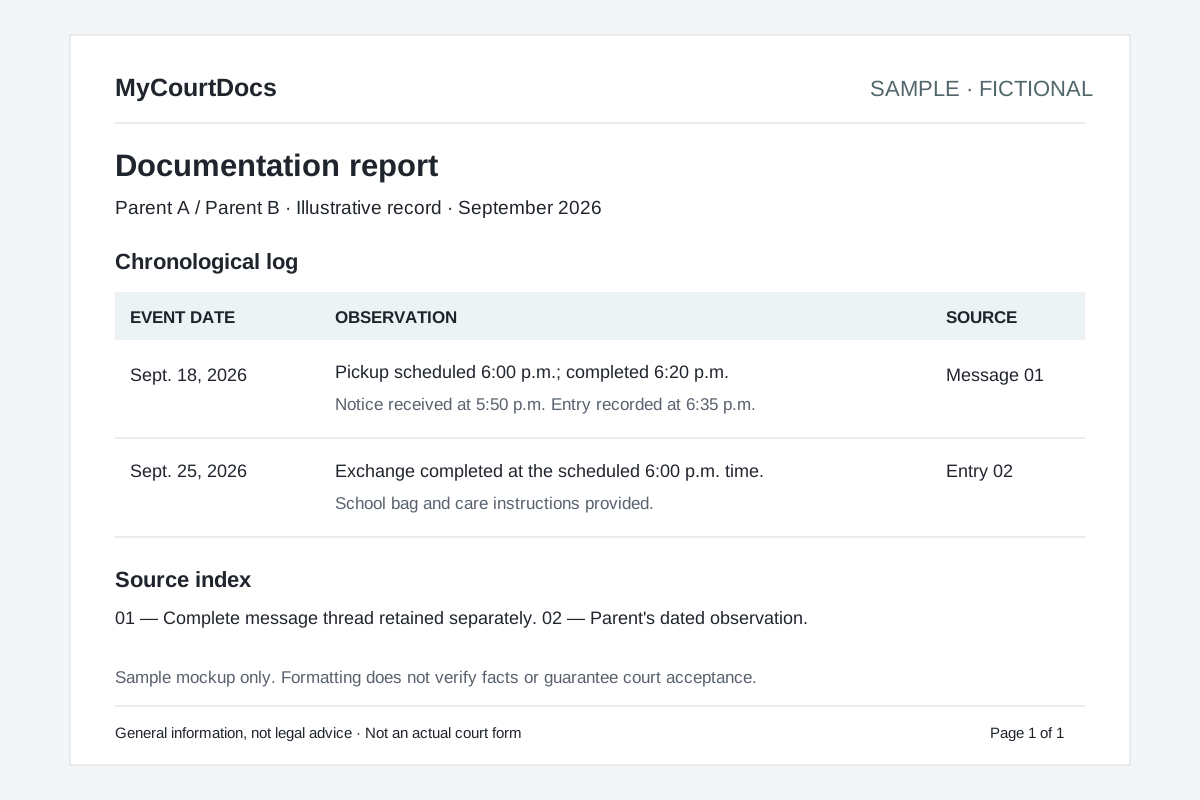
Custody transitions can bring significant emotional tension, especially during high-conflict disputes. When private drop-offs lead to recurring conflict or safety concerns, family courts or mutual parenting agreements often designate a neutral, public venue. Conducting transfers at a designated safe exchange location, such as a municipal law enforcement facility or a specialized community center, provides an objective backdrop designed to protect both parents and the children.
Moving transfers to a public site reduces opportunities for confrontation, but it does not remove the need for careful personal records. Even in parking lots equipped with security cameras, disputes about timeliness, demeanor, and missing items still arise. Keeping an accurate, court-ready log of every transition ensures that facts take precedence over conflicting memories if you ever need to present your history to family court.
Why Courts Designate a Police Station Custody Exchange
Family courts prioritize the physical safety and psychological well-being of the children above all else. When past exchanges have involved verbal conflict, intimidation, unannounced third parties, or repeated failures to appear, a judge may formalize a police station custody exchange in the temporary orders or final parenting plan.
Designated municipal locations generally fall into two broad categories:
- Law Enforcement Precincts: Many local police departments and county sheriff offices maintain designated "Safe Exchange Zones" in their public parking lots or station lobbies. These areas typically feature well-lit stalls, 24-hour recorded video surveillance, and proximity to sworn officers.
- Supervised Exchange Centers: These specialized community facilities employ neutral monitors who coordinate the handoff. In many centers, parents arrive at staggered intervals using separate doors so they never encounter one another directly.
While police parking lots offer deterrence against overt misconduct, law enforcement personnel generally do not monitor standard parenting transitions. Officers will not supervise the exchange, sign private attendance sheets, or step outside unless an urgent safety issue arises. You remain solely responsible for logging what happens, tracking the exact timing, and maintaining your records.
When transitions carry elevated stress, learning how to document missed custody exchanges in writing becomes an essential safeguard alongside your on-site observations.
The Legal and Practical Rules for Recording at Public Exchange Sites
Many parents ask whether they should hold up a phone to record audio or video during a tense exchange. While capturing footage feels like an immediate way to secure proof, recording in public spaces—and especially inside government buildings—involves complex legal considerations that vary across jurisdictions.
Audio Wiretapping and Consent Laws
States classify wiretapping and electronic surveillance under distinct standards. In "one-party consent" states, an individual may legally record a conversation they are participating in without alerting the other speaker. In "all-party consent" (or two-party consent) states, recording private conversations without the consent of everyone involved can constitute an unlawful act, rendering the recording inadmissible in court or even exposing the person recording to statutory penalties.
Determining whether an outdoor police precinct parking lot carries an "expectation of privacy" depends on state statutes and case law. Because these legal thresholds vary widely, you should never assume a covert audio recording is legally permissible. Consult a family law attorney in your jurisdiction before recording conversations.
Station House Policies on Photography and Filming
Police facilities routinely enforce strict administrative policies regarding filming on their premises:
- Lobbies and Secure Entrances: Many departments prohibit photography and video recording inside station lobbies to protect undercover officers, confidential informants, administrative terminals, and crime victims reporting incidents.
- Parking Lots: Outdoor spaces may allow recording from a constitutional standpoint, but overt filming often escalates tension between co-parents and can prompt officers to intervene to maintain public peace.
- Surveillance Footage Limitations: Never rely on the police department's security cameras to preserve evidence for your family court case. Station camera footage is generally captured for facility security, stored on short automated overwrite loops, and rarely released to civil litigants without a formal judicial subpoena.
Instead of pointing a handheld camera at the other parent, focus on objective, written tracking. A steady personal record avoids confrontation while creating clear documentation that judicial officers can review without evidentiary hurdles.
What to Track in a Supervised Exchange Log
Maintaining a consistent supervised exchange log allows you to present an organized, factual timeline of your parenting time transitions. Whether you complete the handoff in a supervised facility or an open precinct lot, record your entries as close to real time as possible.
A thorough log should include:
- Scheduled Time vs. Actual Time: Note the precise time specified in your court order, the minute you arrived, the minute the other parent arrived, and the minute the exchange concluded.
- Specific Location Details: Document where your vehicle was parked (such as "Precinct 4 North Visitor Lot, Space 12") or whether you checked into an interior lobby.
- Third Parties Present: List any individuals accompanying either parent. Note whether companions remained seated inside the vehicle or approached the exchange area.
- Children's Possessions and Equipment: Track the transfer of essential personal items, including car seats, school backpacks, seasonal clothing, or medical supplies.
- Observable Behavior: Limit your notes to verifiable, sensory facts rather than emotional characterizations. Write what was said or done without inserting assumptions about motivations.
``` PRACTICE ENTRY TEMPLATE:
Date: October 14, 2024 Scheduled Exchange Time: 5:00 PM Designated Location: Municipal Police Dept., Public Safe Exchange Zone
Arrival Details:
- My arrival: 4:52 PM (parked in stall marked "Safe Exchange Zone")
- Children in vehicle: Maya (age 7), Ethan (age 5)
- Other parent arrival: 5:18 PM (parked two stalls away)
Handoff Summary:
- Other parent exited vehicle at 5:19 PM.
- Walked children to the rear of other parent's vehicle.
- Transferred school backpacks, sports gear, and prescription inhaler.
- Exchange completed at 5:22 PM. Total departure time: 5:24 PM.
Observations:
- Other parent arrived 18 minutes past the scheduled time without advance written notification.
- No verbal communication took place aside from confirming the inhaler was in Maya's front pocket.
```
If the handoff involves ongoing care regimens, review our guide on medication custody exchange: a parent's guide to handoffs to ensure prescription logs align with your transition notes.
Objective Language vs. Emotional Commentary
Judges, parenting coordinators, and guardians ad litem read hundreds of conflict reports. Emotional rhetoric, subjective labels, and diagnostic accusations tend to obscure the facts and can damage your credibility. When preparing documentation, adopt the tone of an impartial court reporter.
Consider how these contrasting descriptions alter the tone of a record:
| Subjective Description | Objective, Verifiable Observation | | :--- | :--- | | "The other parent arrived furious and started aggressively intimidating me in front of the children." | "The other parent arrived at 5:20 PM, closed the driver's side door with force, and stated in a raised voice, 'You should have had them ready.' I did not respond." | | "Co-parent deliberately sabotaged the drop-off by acting completely erratic and unstable." | "The other parent stood by my vehicle window for four minutes asking repeatedly why I changed routes, then walked back to their car without securing the child's booster seat." | | "They were extremely late as usual because they have zero respect for the custody agreement." | "Scheduled time was 6:00 PM. The other parent arrived at 6:35 PM. I received no text message or app notification regarding the delay." |
By stating exact times, direct quotations, and observable actions, you allow the facts to demonstrate patterns over time. If chronic delays continue across multiple weeks, review our recommendations on how to document a pattern of late pickups for child custody.
How to Establish Verifiable Timestamps and Neutral Corroboration
A personal written journal holds value, but pairing your notes with third-party verification provides stronger support if the other parent disputes your timeline. You can substantiate your presence at a designated location without violating recording boundaries through several reliable methods:
Digital Communication and In-App Messaging
When you pull into the facility parking lot, send a brief, courteous message through your court-approved co-parenting application or designated messaging channel:
"Arrived at the Central Precinct safe exchange lot for the 5:00 PM transition. Parked in space 4."
This creates an immediate, tamper-evident digital timestamp linked directly to your account. If the other parent arrives late, send a follow-up confirmation after an appropriate waiting window:
"It is currently 5:20 PM. I am still parked in space 4 awaiting arrival."
Location Metadata and Physical Receipts
- Smartphone Location Services: Most modern smartphones automatically attach date, time, and GPS coordinates to photographs. Taking a photograph of your dashboard clock or the station's exterior sign establishes a digital metadata trail.
- Nearby Retail or Parking Receipts: If you stop immediately before or after the transition, purchasing a bottle of water or obtaining a printed parking validation ticket from an automated precinct machine gives you an independent time-stamped record.
- Vehicle Telematics and Dashcam Footage: Outward-facing vehicle dash cameras that continuously run can record your car's arrival and departure times via GPS telemetry. Ensure dashcam audio settings comply with your local recording statutes.
To transform these daily records into organized, court-admissible submissions, use a dedicated platform to document custody for court so your timestamps, exportable logs, and communication threads remain linked in a secure format.
Responding to Delays, Non-Appearances, and Escalations
Even at a municipal law enforcement facility, exchanges do not always proceed smoothly. Having a clear plan of action helps you remain composed when a transition breaks down.
Managing Extended Delays and No-Shows
- Wait the Court-Mandated Period: Parenting plans often outline a standard grace period (frequently 15 to 30 minutes). Remain in your vehicle with your child until that period expires.
- Send One Neutral Inquiry: After 15 minutes, send a single written message inquiring whether the other parent is en route. Avoid repeated calls or messages.
- Document Your Departure: When the grace window closes without contact, send a final written notice indicating that you waited, received no update, and are departing with the child.
- Preserve Your Exit Time: Take a time-stamped photo or obtain a physical receipt immediately upon leaving the area to confirm the duration of your stay.
De-Escalating Hostile Encounters
If the other parent exits their vehicle, approaches your space, or engages in disruptive conduct, prioritize your physical safety and the emotional security of your children:
- Keep Doors Locked and Windows Up: Avoid exiting your vehicle to debate schedule details or past disagreements in the parking lot.
- Keep Verbal Responses Minimal: If communication is necessary, keep your tone level and strictly focused on logistics (e.g., "The backpacks are placed on the curb").
- Enter the Station Lobby if Necessary: If you experience direct intimidation or a credible threat to safety, drive your vehicle closer to the station entrance or walk calmly with your children into the public lobby to request administrative assistance.
- Do Not Request Arrests Over Schedule Disputes: Officers will not interpret civil parenting orders or enforce parenting time disputes on the spot. Only engage station staff if there is an active safety concern.
By approaching every exchange with preparation, professional language, and consistent logging habits, you protect your children from direct conflict while creating a reliable, transparent record for your family law matter.
This article is for informational purposes only and is not legal advice. Consult a licensed attorney in your jurisdiction.
Frequently Asked Questions
Will police officers monitor our custody exchange and verify my log?
Police officers generally do not monitor civil parenting exchanges or sign personal logs. While officers are nearby if an urgent safety issue occurs, you remain responsible for logging arrival times, departures, and observable facts yourself.
Is it legal to record video on my phone during a custody exchange at a police station?
Recording rules vary significantly by state. Some jurisdictions require all parties to consent before recording conversations, and many police stations prohibit filming inside lobbies. Consult a local family law attorney before taking audio or video recordings during exchanges.
How long should I wait at the safe exchange location if the other parent is late?
Most court orders include a standard grace period, typically 15 to 30 minutes. If your order does not specify a timeframe, waiting 15 to 20 minutes while sending one neutral check-in message is standard practice before documenting your departure.
What should I do if the other parent causes a scene in the police parking lot?
Do not exit your vehicle to debate or argue. Keep windows closed and doors locked. If you feel unsafe or the situation escalates, walk into the public police station lobby with your children or dial dispatch for on-site assistance.
Can I request surveillance camera footage from the police department for my custody hearing?
Station security footage is maintained for facility safety, typically stored on short overwrite cycles, and rarely released to parents without a formal court subpoena. Always maintain your own time-stamped records and check-in logs.