Documenting a Co-Parent's Social Media Posts Appropriately
· By MyCourtDocs
Learn how to document a co-parent's social media posts appropriately for family court while avoiding common privacy and admissibility mistakes.
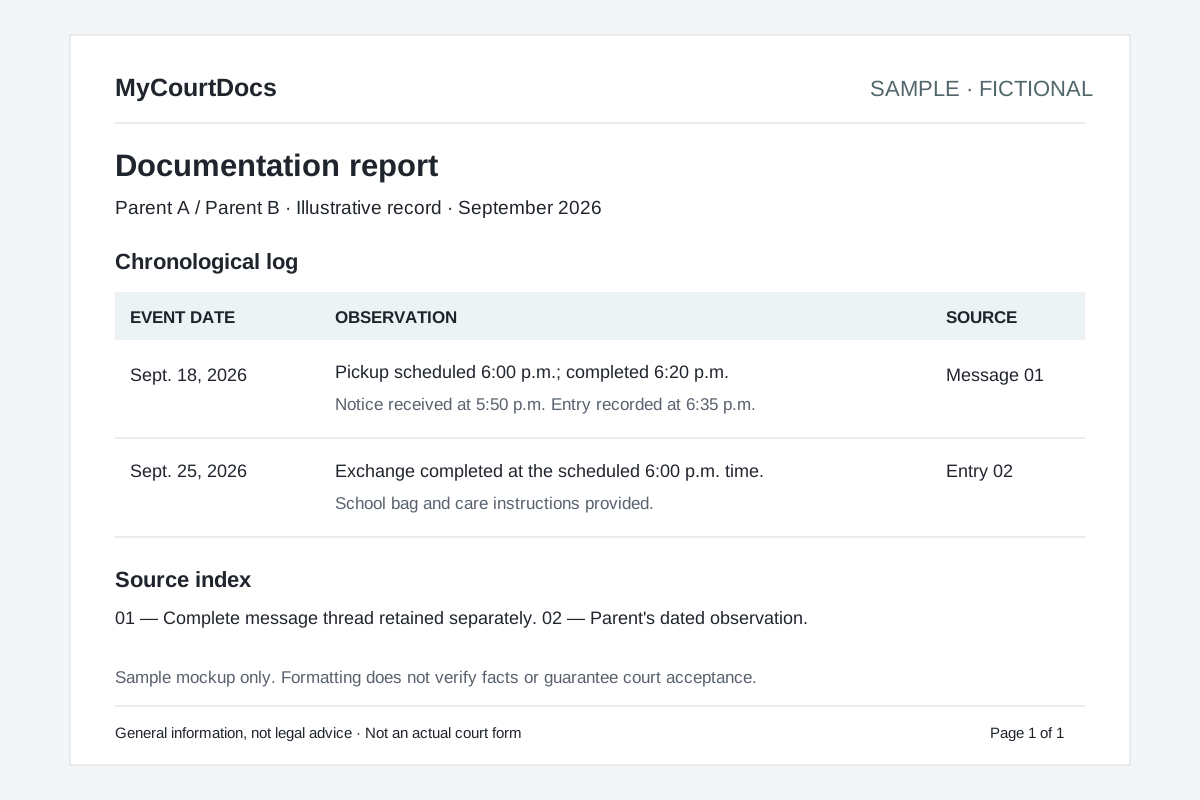
Public social media activity frequently surfaces in family court proceedings. When a co-parent shares updates online, those posts can sometimes contradict sworn court statements, highlight safety issues, or document parenting schedule violations. However, bringing digital evidence into a custody hearing involves strict rules regarding authenticity, relevance, and privacy.
Understanding how to preserve social media custody evidence appropriately protects your credibility while providing your legal representative with clean, usable documentation. Here is a clear guide on what matters, how to save it, and how to maintain healthy boundaries while doing so.
What Types of Social Media Posts Matter in Family Court
Judges are generally uninterested in ordinary interpersonal friction, minor venting, or petty relationship drama. Bringing hundreds of irrelevant screenshots to court can frustrate a judge and undermine your credibility. For evidence to matter, it must directly connect to the best interests of the child or the specific terms of your parenting plan.
Key categories of social media custody evidence include:
- Disparagement or direct parenting interference: Posts or comments where the other parent publicly insults your parenting, encourages the child to defy household rules, or shares confidential legal documents.
- Child safety and supervision concerns: Images or videos showing the child in unsafe situations, left unattended, riding in vehicles without proper restraints, or around dangerous substances.
- Direct contradictions of legal or financial claims: A co-parent claiming inability to pay child support while posting public updates about luxury purchases, vacations, or high-cost hobbies. Similarly, claims of being unavailable for visitation due to illness or work while publicly attending social events.
- Violations of specific court orders: Explicit prohibitions against posting photos of the child online, introducing new partners prematurely, or consuming alcohol during parenting time.
When evaluating whether to record an update, ask yourself: Does this post directly impact our child's physical safety, emotional well-being, or the enforceability of our existing order? If the answer is no, capturing it may create unnecessary stress without offering any legal benefit.
How to Properly Preserve Posts for Court
Digital content is inherently fragile. A user can edit, archive, or delete an update within seconds, leaving you with no way to revisit the original source. To preserve posts for court effectively, you must capture complete context rather than cropped fragments.
A simple crop showing only the text of a post rarely meets the standards for legal admission. Much like learning what makes a text message screenshot usable in court, capturing digital evidence requires verifiable technical details:
- Capture the entire screen: Do not crop out the profile name, URL bar, system clock, or battery percentage. The raw, uncropped screen capture shows when and how the image was recorded.
- Include timestamps and dates: Relative timestamps like "2 hours ago" or "Yesterday" lose meaning over time. Hover over or click on the timestamp on a desktop browser to expose the exact date, hour, and minute the item was published before capturing it.
- Capture full context: Include the original post, the author's public profile link or username, and any relevant comment threads. Capturing only an isolated comment makes it easy for the other party to claim the statement was taken out of context.
- Preserve direct URLs: Copy the direct web link (permalink) to the specific post or video, not just the co-parent's general profile page.
- Download original media files: If the update contains a video or high-resolution photo, download the native media file rather than merely taking a still screenshot of a paused video.
Once captured, organize these records systematically. You can use dedicated tools to document custody for court alongside calendar logs, parenting exchange notes, and incident reports so your records remain chronological and searchable.
Avoiding Privacy Violations and Evidence Traps
Courts care deeply about how evidence is obtained. Unlawful access or violating privacy boundaries can result in your evidence being excluded entirely, or worse, civil or criminal liability.
To keep your Facebook posts custody records admissible and legally sound:
- Do not access private accounts unlawfully: Never guess passwords, use saved logins on shared family devices, or access an account without permission. Accessing an account without authorization can violate federal and state privacy statutes.
- Do not use your children to gather information: Never ask your child to monitor the other parent's social media, show you their private messages, or act as an investigator. This places immense emotional strain on the child and reflects poorly on your ability to shield them from adult conflict.
- Avoid creating fake accounts or using "burners": Depending on local court rules and platform terms of service, creating deceptive accounts to bypass privacy blocks can be viewed as harassment or bad-faith conduct.
- Distinguish public vs. shared content: If a mutual friend or family member genuinely sees a public post or receives an update voluntarily and forwards it to you, keep documentation of who sent it and when.
Rules regarding digital evidence and privacy expectations vary significantly by state. Always confirm local admissibility standards with a licensed family law attorney in your jurisdiction before presenting social media records to a judge.
Managing the Emotional Toll of Social Media Monitoring
Constantly monitoring a former partner's online presence creates chronic emotional exhaustion. Searching for infractions can heighten anxiety and pull your attention away from parenting in the present moment.
Developing a structured approach helps protect your peace of mind while maintaining reasonable diligence:
- Treat documentation like a professional task: Set aside specific, limited times to review information if active litigation requires it. Avoid checking profiles late at night or during your scheduled parenting time.
- Evaluate communication boundaries: When digital interactions spill over into direct conflict, it is essential to understand co-parent communication: when to respond, document, or stop to avoid reactive arguments.
- Maintain your own digital cleanliness: Do not use your own social media accounts to vent, post passive-aggressive quotes, or discuss your custody case. Anything you share online can be captured and used by the other party using the exact same methods outlined here.
- Address living arrangements objectively: If social media updates involve new individuals around your child, focus strictly on behavioral observations and safety rather than personal opinions, following established guidelines on documenting concerns about a co-parent's new partner or live-in.
Organizing Your Digital Evidence for Your Attorney
Handing your attorney an unorganized folder of hundreds of unsorted screenshots increases billable hours and slows down your case preparation. Well-structured records make it easier for counsel to identify patterns and prepare formal exhibit packets.
When preparing social media records for legal review:
- Maintain chronological order: Name your files consistently using the date format
YYYY-MM-DD_Platform_Topic(for example,2026-03-14_Facebook_ScheduleContradiction.png). - Pair captures with objective notes: Accompany each screenshot with a brief, factual description: the date captured, the account that posted it, and the specific reason it relates to your parenting matter. Keep your notes free of emotional commentary or personality labels.
- Back up records in multiple locations: Store your evidence securely in the cloud and on an external drive. Do not rely solely on your mobile phone's photo library, where files can be accidentally deleted or compressed.
A disciplined, court-neutral approach ensures that if online behavior impacts your child, you have clear, credible records ready for your legal team.
This article is for informational purposes only and is not legal advice. Consult a licensed attorney in your jurisdiction.
Frequently Asked Questions
Can all of my co-parent's social media posts be used in custody court?
Evidence must directly relate to the child's safety, welfare, or specific terms of your custody order. Irrelevant relationship drama or minor venting is generally dismissed and may frustrate the judge.
Why are cropped screenshots bad for court evidence?
Cropped screenshots often lack critical context such as timestamps, user handles, and URLs, making them easy to challenge. Full-screen captures showing technical details are much more reliable.
Is it legal to use a co-parent's password to access private posts?
No. Logging into someone else's account without explicit permission can violate federal and state privacy laws, making the evidence inadmissible and exposing you to legal penalties.
What should I do if a co-parent deletes a post after sharing it?
Save the post immediately with an uncropped screenshot showing the URL and timestamp, record the direct web link, and note the date and time you observed it before it is taken down.
Can I use a screenshot that a mutual friend forwarded to me?
A screenshot sent to you voluntarily by a third party can often be saved, but admissibility rules vary by state. Consult your attorney regarding third-party evidence in your jurisdiction.