Documenting Concerns About a Co-Parent's New Partner or Live-In
· By MyCourtDocs
Concerned about a co-parent's new partner? Learn how to document objective safety issues and household changes factually for family court without emotional labels.
When a co-parent introduces a new romantic interest or moves someone into their residence, it is natural to wonder how that change affects your child. Family courts generally respect each parent’s right to form new adult relationships. However, judges care deeply about the child's safety, emotional stability, and overall environment.
Navigating new partner custody concerns requires balancing personal feelings with legal relevance. Discomfort or resentment about an ex-partner moving forward is not actionable in family court. To protect your child and present a compelling case if legal intervention becomes necessary, you must learn to identify observable risks and create an objective, factual record.
Distinguishing Actionable Safety Concerns from Personal Discomfort
Family court judges do not evaluate whether a co-parent's new partner is polite, likable, or compatible with your values. Courts focus strictly on whether a new adult in the home poses a risk to the child’s physical, mental, or emotional well-being. Knowing the difference between personal grievances and legal concerns protects your credibility.
Common personal grievances that courts typically disregard include:
- You personally dislike the individual’s personality, lifestyle, or appearance.
- The partner disciplines your child in ways that differ from your preferences, provided the discipline is not unlawful or physically harmful.
- The partner attends routine school functions or sporting events alongside the co-parent.
- The relationship moved faster than you would have preferred.
Conversely, legally relevant concerns about household members in custody disputes generally involve concrete safety issues:
- Verifiable criminal records involving violence, domestic offenses, sexual misconduct, or active warrants.
- Evidence of active substance abuse, illegal drug activity, or driving while impaired with the child present.
- Observable neglect, safety hazards in the shared residence, or leaving young children unsupervised with an unfamiliar adult.
- Inappropriate physical discipline, threats, or severe behavioral volatility witnessed by third parties or reported consistently by the child.
If your situation requires formal legal filings, learning how to properly document custody for court ensures your evidence highlights real welfare concerns rather than interpersonal friction.
What to Look For: Observable Behaviors and Safety Factors
When evaluating the impact of a live-in partner or frequent visitor, you must focus entirely on tangible facts. Rather than writing down your interpretation of a situation, record what was seen, heard, and verified through credible records.
Criminal History and Background Concerns
If you have genuine safety worries regarding a live-in boyfriend or girlfriend, public records searches can provide factual information. Look for certified records of convictions, active protective orders, or sex offender registry listings. Avoid relying on neighborhood rumors or unverified social media accusations. State laws vary regarding how background checks may be used in family court, so confirm procedures with a local family law attorney.
Living Conditions and Sleeping Arrangements
A child's physical environment must be safe and appropriate for their age. Take factual notes if a child reports that the new partner's presence has eliminated their dedicated sleeping area, or if the home lacks basic utilities, food, or functional safety equipment. Record dates, times, and exact statements rather than broad assertions like "the living conditions are terrible."
Supervision and Primary Caretaking Duties
Sometimes a co-parent delegates significant parenting responsibilities to a new romantic partner shortly after meeting them. If the co-parent is absent for extended periods while the child is left with a third party, this may impact existing custody arrangements or right-of-first-refusal clauses. Record who conducts drop-offs and pick-ups, who attends medical appointments, and how often the other parent is physically present during their allotted custodial time.
How to Record Incidents Factually and Without Subjective Labels
The language you use in your documentation determines whether a judge views you as a vigilant, protective parent or an uncooperative former partner. Using loaded labels weakens your position. A judge cannot verify an emotional label, but they can verify an objective description of an event.
When creating entries in your custody log, follow these principles:
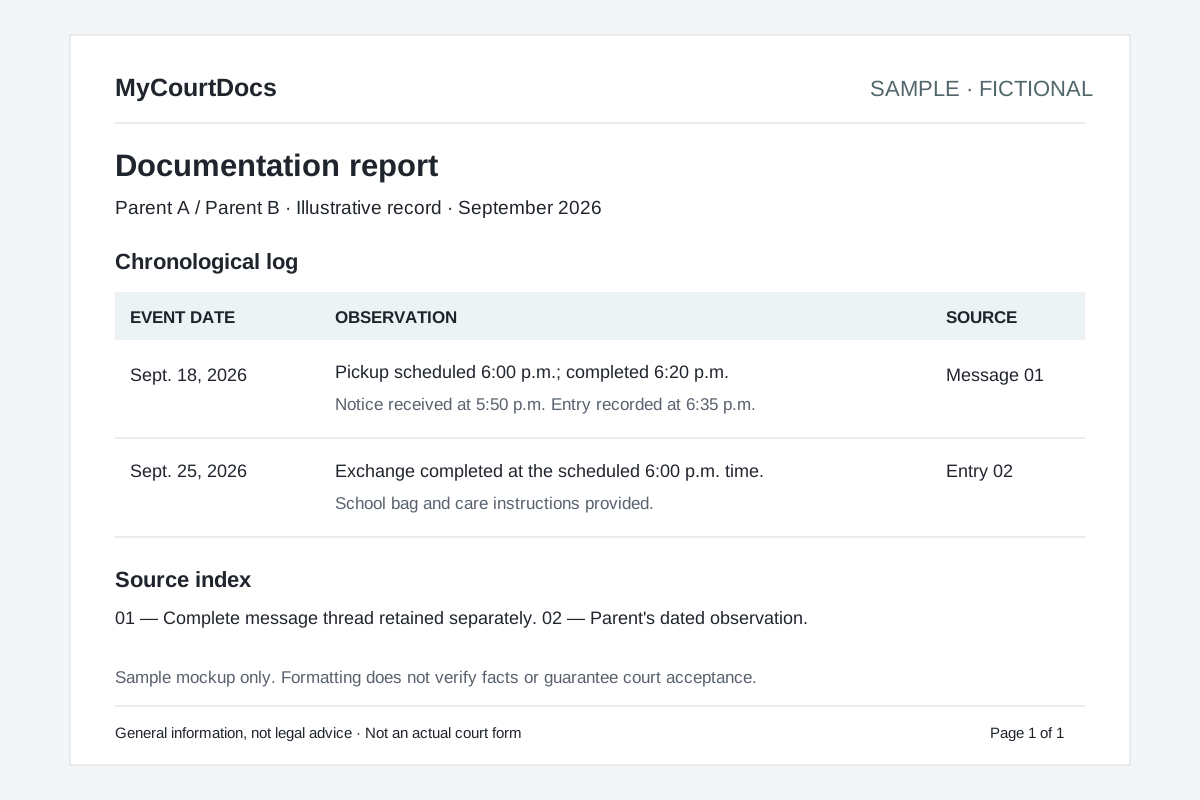
- Use the "Camera Rule": Write only what an objective video camera would capture. Record physical actions, tone of voice, spoken words in direct quotes, and timestamps.
- Exclude Diagnostic and Character Labels: Avoid terms like "dangerous," "unstable," or "hostile." Instead, write: "The individual shouted profanities while standing three feet from the vehicle during the 5:00 PM exchange on October 12."
- Capture Immediate Child Reactions: Note visible behaviors without coaching the child. If a child expresses reluctance to return to the home, record their exact words and demeanor. For more details on handling this sensitive issue, review our guide on how to document reluctance for court when a child refuses visitation.
| Subjective Note (Avoid) | Objective Note (Use Instead) | | :--- | :--- | | "The new boyfriend was aggressive and threatened me at drop-off." | "On Nov 4 at 6:15 PM, [Partner Name] walked to my car window, raised his voice, and stated: 'You need to leave right now.' The child was in the backseat." | | "The co-parent's live-in partner is an unfit drunk who neglects our daughter." | "On Oct 18 at 8:00 AM, the school reported the child arrived without lunch or a jacket. The child stated [Partner Name] was sleeping on the couch and did not wake up before she left." | | "They are living in a chaotic, unsafe party house." | "On Sept 22 at 9:30 PM, the child called from the residence. Loud music and shouting were audible in the background. The child stated there were six unfamiliar adults drinking in the living room." |
Keeping clean records is essential if you ever need to present evidence at a hearing. To understand how to organize these entries for a legal team, read our resource on building a court binder and what to include.
Collecting Third-Party Corroboration
Judges often view statements made by one parent against another as competing personal opinions. Third-party evidence provides neutral, reliable confirmation of your concerns about household members and custody arrangements.
Valuable third-party sources include:
- School and Daycare Records: Attendance reports, tardiness records, missing homework logs, or notes from teachers regarding sudden changes in academic performance or emotional regulation.
- Pediatrician and Mental Health Notes: Medical chart notes from doctors, dentists, or licensed counselors who have evaluated the child’s physical health or noted disclosures made during therapy sessions.
- Police Reports and Official Incident Logs: If an incident occurs that requires law enforcement response—such as a disturbance, property damage, or domestic call at the residence—obtain the official incident number and a copy of the public report.
- Neutral Witness Statements: Written, dated observations from neighbors, coaches, or neutral exchange supervisors who observed specific interactions firsthand.
Never involve your child in gathering evidence. Do not interrogate them after visits, ask them to take photographs of the other home, or instruct them to spy on the new partner. Courts view parental coaching and interrogations as harmful to the child, which can severely damage your standing in custody proceedings.
Communicating Concerns Directly with the Co-Parent
Before seeking emergency orders or filing a motion to modify custody, you should generally attempt to address legitimate safety issues directly with the other parent, provided there is no protective order barring contact. Written communication creates a clear paper trail showing that you attempted to resolve the issue reasonably.
Keep all written correspondence focused exclusively on the child's needs:
- Stay Brief and Courteous: State the specific observation or safety question without lecturing, accusing, or questioning their lifestyle choices.
- Ask Informational Questions: For example, write: "Could you confirm who will be supervising our son after school on Tuesdays and Thursdays while you are at work?"
- Keep Everything in Writing: Use email or a court-approved parenting application so all messages are time-stamped, unalterable, and easily exportable.
If you are dealing with challenging communication patterns, learning how to document problematic co-parenting behaviors without labels will help you maintain an unassailable communication record.
When to Seek Legal Advice or Modification
Every state handles custody modifications differently. In general, courts require proof of a "material change in circumstances" that directly impacts the child’s best interests before they will modify an existing custody order or parenting plan.
The introduction of a new partner alone rarely qualifies as a material change. However, a significant change may exist if:
- The new partner’s presence creates an unsafe, unstable, or hazardous home environment.
- The partner has a verified history of crimes against children, violent offenses, or serious active addictions.
- The co-parent has effectively relinquished parenting responsibilities to the third party in violation of the custody agreement.
- The child exhibits severe behavioral regression, anxiety, or physical neglect verified by healthcare professionals.
If you observe patterns that endanger your child, consult a qualified family law attorney in your jurisdiction immediately. An attorney can help you determine whether your documented evidence meets the legal threshold for an emergency ex parte motion, an order for a custody evaluation, or a standard motion for modification.
This article is for informational purposes only and is not legal advice. Consult a licensed attorney in your jurisdiction.
Frequently Asked Questions
Can a judge stop my co-parent from introducing our child to a new partner?
Courts generally do not prevent a parent from introducing a partner unless there is a specific restriction in the custody order or the individual poses a proven, direct threat to the child's safety or well-being.
Is a live-in partner allowed to stay overnight during parenting time?
Some custody agreements contain a morality clause or a cohabitation clause restricting non-related overnight romantic guests while the child is present. Check your current court order and discuss enforcement options with a local attorney.
What should I do if the new live-in partner has a criminal record?
If you have verifiable evidence that a new resident has a violent criminal history, an active protective order, or a history of child abuse, compile official public records and consult your family law attorney about filing a motion to modify custody or requesting a restraining order.
How do I document things my child tells me about the new partner?
Ask open-ended questions about how their day went rather than asking leading questions about the adult. Record their spontaneous statements verbatim in your log with the date and time, without pressuring them for details or coaching their responses.