Documenting a Co-Parent's Substance Use Safely and Legally
· By MyCourtDocs
Worried about a co-parent's substance use? Learn how to document observable facts, protect child safety, and gather legal evidence without crossing boundaries.
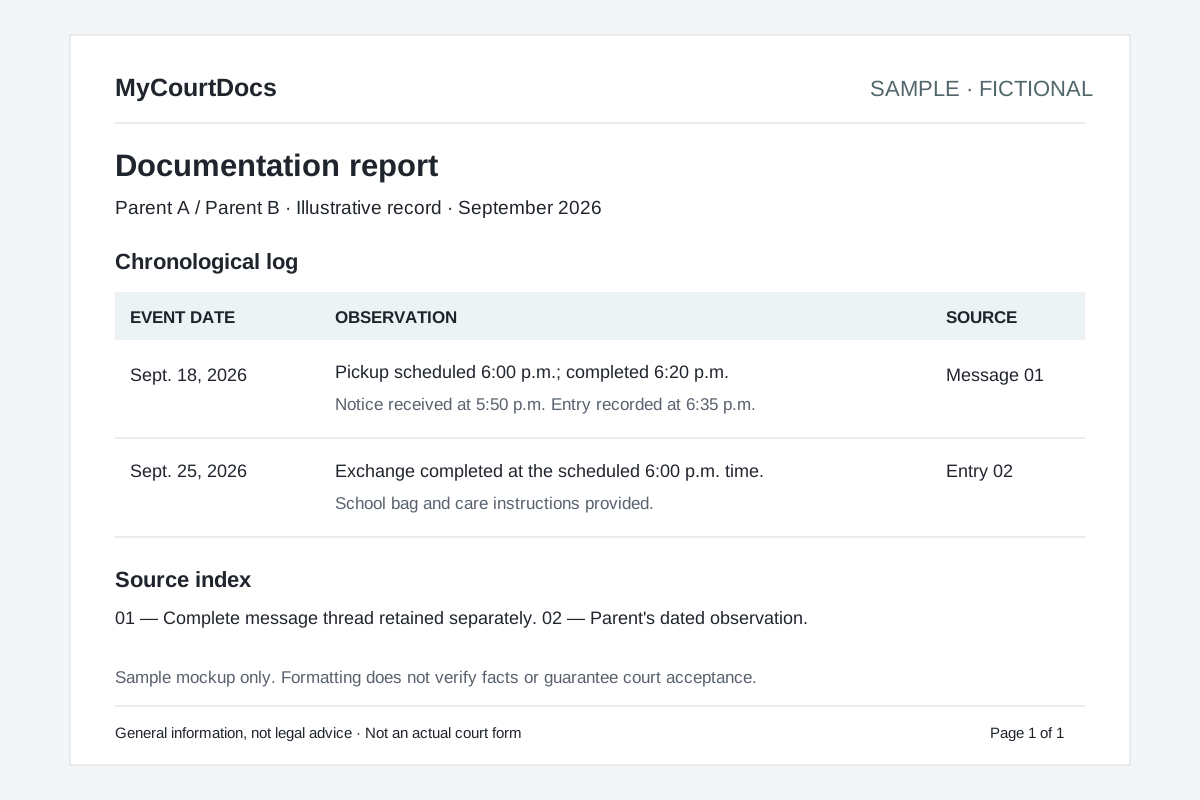
Suspecting or knowing that a co-parent is misusing alcohol or drugs while caring for your children is one of the most frightening situations a parent can face. Your first instinct is naturally to protect your child immediately. However, taking the wrong steps can escalate conflict, compromise your credibility in family court, or inadvertently cross legal boundaries.
To address safety concerns custody cases often involve, you must focus on objective reality rather than suspicion, emotion, or personal labels. When you document custody for court, judges and family court evaluators look for calm, factual accounts showing how a co-parent substance use custody issue directly impairs parenting capacity and child welfare.
Here is a practical guide to documenting substance use concerns safely, legally, and effectively.
Focus on Observable Facts Rather Than Conclusions
Family court judges do not rule on hunches, diagnoses, or character judgments. Saying "my co-parent is an alcoholic" or "they were high at the exchange" gives a court very little actionable evidence. Instead, focus strictly on observable, sensory details and concrete events.
When you record an incident, document exactly what you saw, smelled, and heard:
- Sensory observations: Note the smell of alcohol on their breath, slurred speech, bloodshot eyes, unsteady gait, or stumbling.
- Physical evidence: Describe open containers visible in a vehicle, discarded paraphernalia in common areas, or uncollected medication bottles.
- Time and context: State the exact date, time, location, and who was present during the observation.
- Direct quotes: Record the other parent's exact statements rather than interpreting what you think they meant.
For example, compare these two entries:
- Subjective entry: "The co-parent was drunk again at drop-off and acted crazy."
- Objective entry: "At the 5:30 PM exchange on Friday, October 12, the co-parent arrived 25 minutes late. When stepping out of the driver's seat, they swayed and leaned on the car door for balance. Their speech was slurred, and I detected a strong odor of alcohol from two feet away. They dropped the child's backpack twice while walking to the curb."
The second entry gives your attorney or a judge concrete details to evaluate. Objective records demonstrate your composure and help keep the focus entirely on child safety.
Documenting the Direct Impact on Parenting and Child Safety
In family law proceedings, the central standard is almost always the best interests of the child. Documenting that an adult drinks alcohol is rarely enough on its own, as moderate adult consumption is lawful. What matters to a court is whether co-parent substance use custody arrangements are compromised because the behavior impairs parenting abilities or places children in danger.
Pay close attention to specific lapses in care and safety routines, such as:
- Supervision failures: Leaving young children unattended, sleeping through scheduled meal times, or failing to wake up to get children ready for school.
- Transportation risks: Attempting to drive children while visibly impaired, failing to secure car seats, or missing agreed exchange locations due to disorientation.
- Missed commitments: Failing to administer prescribed medications to the child, missing pediatric appointments, or failing to pick up children from school or daycare.
- Condition of the children: Children returning from visits unwashed, wearing soiled clothes, reporting that there was no food in the house, or describing being left alone for extended periods.
Keep records of official school attendance reports, medical records, and daycare sign-in sheets. These third-party records serve as unbiased corroboration of disruption in your child's routine. If you notice that unusual behaviors coincide with new individuals in the other home, reviewing guidance on documenting concerns about a co-parent's new partner or live-in can help you capture those home environment details appropriately.
Gathering Evidence Legally and Avoiding Unlawful Surveillance
When trying to document drinking custody problems or illicit drug use, parents often wonder how far they can go to gather proof. It is critical to avoid actions that could violate federal or state privacy laws, wiretapping statutes, or court orders. Evidence obtained illegally can be excluded from court and may subject you to civil liability or criminal charges.
Keep these safety and legal boundaries in mind:
- Audio and video recordings: Recording laws vary significantly by state. Some jurisdictions require the consent of all parties to record a conversation, while others require only one party's consent. Never attempt to record inside the other parent's private residence, vehicle, or personal space without legal advice.
- Digital privacy: Do not hack into the other parent's phone, email, social media accounts, or personal devices. Do not install unauthorized tracking apps or spyware.
- Search and seizure: Do not trespass onto the other parent's property or search their private bags, vehicle, or personal belongings.
- Involving the children: Never ask your children to spy, take photos, search through cabinets, or report back on the other parent's habits. Interrogating children places immense psychological stress on them and can severely harm your position in court.
Rely instead on public interactions, written communications, third-party witnesses, and official records. Knowing how to handle digital exchanges is vital; our guide on co-parent communication: when to respond, document, or stop outlines how to handle erratic messages without engaging in conflict.
Leveraging Third-Party Reports and Objective Documentation
Your personal logs are a vital foundation, but judges place high value on independent, neutral third-party documentation. Neutral records eliminate the "he said, she said" dynamic that frequently bogs down custody litigation.
Consider which objective sources may already exist or could become relevant:
- Written communications: Save text messages, emails, voicemails, or messages sent through co-parenting apps. Look for messages sent at odd hours (such as 3:00 AM) that contain disorganized thoughts, aggressive language, or admissions of impairment.
- First responder records: If the co-parent's condition ever creates an immediate, dangerous emergency, your primary responsibility is to contact emergency services (such as calling 911). Police incident reports, field sobriety tests, arrest records, and paramedic call logs are public or discoverable records that provide high-value evidence.
- Child welfare investigations: If child protective services or a local child welfare agency investigates a report, request copies of their formal findings once available.
- Witness statements: Neutral witnesses—such as school crossing guards, daycare workers, pediatricians, sports coaches, or neighbors—can offer statements regarding what they personally saw or heard.
If you believe substance misuse requires formal testing, speak with your attorney. In many jurisdictions, courts can order random drug screenings, alcohol monitoring devices (such as continuous transdermal monitors or portable breathalyzers before and after parenting time), or specialized substance abuse evaluations.
Responding to Immediate Impairment During Custody Exchanges
The most acute challenge arises when the other parent appears visibly impaired at a scheduled custody exchange. You may feel torn between following a court order and protecting your child from immediate physical danger.
To navigate this difficult moment safely:
- Prioritize physical safety: If the co-parent attempts to drive away with the child while visibly impaired, do not initiate physical contact or place yourself in harm's way. Insist calmly that the child remain with you or offer to drive the child yourself.
- Contact law enforcement if danger is imminent: If the other parent refuses and insists on driving the child while showing clear signs of intoxication, contact 911 immediately. Report the make, model, license plate, and direction of travel, along with the specific physical signs of impairment you observed.
- Document the entire encounter immediately: As soon as the situation is stable, write down an exhaustive timeline of events. Record the exact words spoken, the physical actions taken, any witnesses present, and the response of law enforcement.
- Notify your legal counsel: Contact your family law attorney right away. They can advise you on whether the event warrants an emergency motion for temporary custody modification, supervised visitation, or mandatory testing before future visits.
Dealing with substance misuse in a co-parent is stressful and heartbreaking, but maintaining a disciplined, factual, and legally sound documentation log will give your legal team the tools needed to prioritize your child's well-being.
This article is for informational purposes only and is not legal advice. Consult a licensed attorney in your jurisdiction.
Frequently Asked Questions
How do I document suspected drinking without sounding like I am making assumptions?
Describe observable physical indicators rather than labels. Write down slurred speech, alcohol odor, unsteady balance, bloodshot eyes, and specific times or dates. Note concrete impacts such as arriving late or leaving child care items behind.
Can I secretly record my co-parent to prove they are intoxicated?
Recording laws vary significantly by state. Some states require all parties to consent to an audio or video recording, while others require only one party. Never record inside another person's private residence or vehicle without consulting a local attorney.
What should I do if the co-parent arrives impaired for a custody exchange?
If you genuinely believe your child is in immediate physical danger (such as an impaired parent attempting to drive), do not allow the child in the vehicle and call 911 immediately. Document the incident thoroughly and notify your attorney to address emergency court relief.
Should I ask my child to take pictures or report on the other parent's drinking?
No. Never ask your children to gather evidence, search through personal items, or report on a parent's habits. Doing so places unfair emotional pressure on the child and can damage your credibility with custody evaluators and judges.
Can I demand that my co-parent submit to a drug or alcohol test?
You cannot personally force a co-parent to take a test, but your attorney can file a motion asking the family court to order random testing, hair follicle tests, or alcohol monitoring devices as a condition of parenting time.