Build a record around relevant events
A documentation checklist is an organization aid, not a requirement to gather every item. Focus on events relevant to your actual parenting arrangement. Use an event date, entry date, local time, topic and source reference so another reader can understand the sequence.
Include scheduled and actual exchanges, agreed changes, relevant communications, child-related appointments and expenses. Record ordinary fulfilled responsibilities too. Avoid adding speculation just to fill a blank field; ‘not known’ is more accurate than a guess.
- Current order or agreed schedule, with its effective date
- Exchange log with scheduled and actual times
- Relevant complete communications, including your replies
- Care and appointment observations with source identified
- Expense amounts, purpose, receipts and reimbursement status
Connect examples to original material
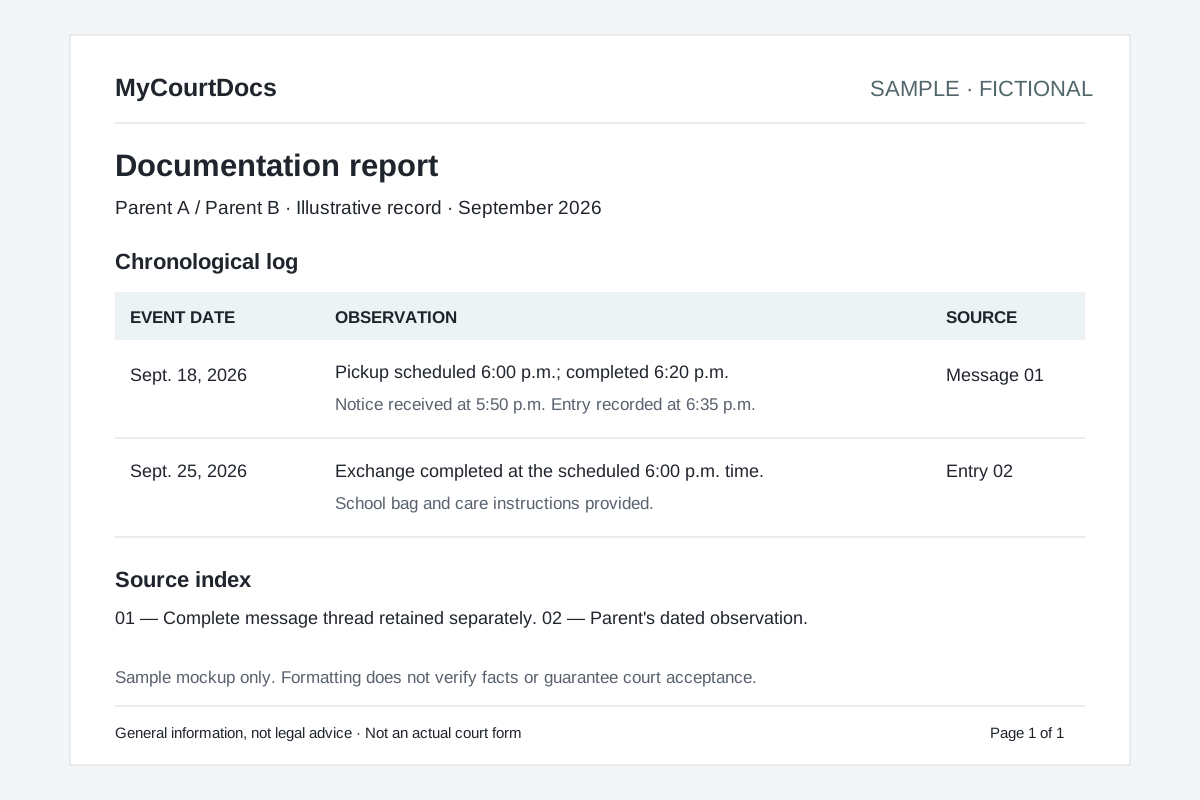
Each example below is fictional and demonstrates the difference between a conclusion and a record someone can follow. Use your own accurate facts rather than copying sample wording. A message reference points to a retained conversation; it is not a substitute for the conversation itself.
For expenses, distinguish an amount paid from an amount requested or reimbursed. For care, distinguish personal observations from what a provider or another person reported. Do not decide another parent's legal responsibility in the log.
Fictional examples: emotional vs. factual entries
All dates, events and parent labels below are fictional. Use the structure, not the invented facts.
Schedule change
Emotional wording: “Changes everything whenever convenient.”
Factual wording: Fictional example — September 12, 2026: Parent B requested moving pickup from 5:00 p.m. to 6:00 p.m. Parent A agreed by message at 2:15 p.m. Exchange occurred at 6:00 p.m. Full thread retained as change-01.
Child-related expense
Emotional wording: “Refuses to help with any costs.”
Factual wording: Fictional example — September 14, 2026: Parent A paid $24.00 for the school activity fee. Receipt retained as receipt-01. A reimbursement request was sent September 15; no payment had been recorded as of September 18. Responsibility is not determined by this entry.
Check completeness without overcollecting
Before a weekly review, check that relevant entries identify dates, sources and uncertainty. Keep the necessary surrounding context and explain corrections. Do not alter original files or present selective screenshots as a complete conversation.
Collect only information you are entitled to retain. Avoid unnecessary identifying or sensitive details about children and other people. Ask an attorney about recording laws, disclosure duties and whether particular records should be requested through an appropriate process.
- Event time and entry time are distinct
- Direct observations are separate from reports
- Quotes can be checked against originals
- File names or reference numbers locate the source
- Routine events and corrections retain context
- Private information is reviewed before any sharing
Create an organized review packet
Use a chronological index with one reference for each supporting file. Organize copies by topic while keeping unmodified originals backed up separately. Note missing material and avoid claiming it establishes something you cannot verify.
An organized PDF can make records easier to navigate, but formatting does not prove a statement, authenticate a file or guarantee acceptance or an outcome. A licensed attorney can advise on relevance, redaction, disclosure and filing requirements.