Define the schedule you are tracking
Begin with the current order or agreement and identify its effective date. Keep the original schedule separate from the actual exchange record. If an arrangement changes, note the relevant message or agreement and whether it was accepted rather than silently changing the original plan.
Use local dates and times and identify the time zone if parents are in different locations. A log can describe an exchange; it does not interpret an order, decide whether a violation occurred or calculate legal entitlements.
- Scheduled start and end, with schedule reference
- Actual start and end, or an explicit unknown
- Exchange location and parent involved
- Notice time and complete message reference
- Agreed change and how agreement was documented
Record exchanges consistently
Make a brief entry near the exchange. Note the scheduled time, actual arrival or completion time and any relevant notice. Include on-time handoffs and successful arrangements using the same fields as delayed or missed exchanges.
If an exchange does not occur, record what you observed, how long you were present and the relevant communication. Do not infer why the other parent was absent. If you could not directly observe the event, identify the source of the information.
Fictional examples: emotional vs. factual entries
All dates, events and parent labels below are fictional. Use the structure, not the invented facts.
Delayed handoff
Emotional wording: “Late again and trying to ruin the weekend.”
Factual wording: Fictional example — September 18, 2026: handoff scheduled for 6:00 p.m.; completed at 6:20 p.m. Notice received at 5:50 p.m. stating an estimated 20-minute delay. Source: exchange-01. Entry recorded at 6:35 p.m.
Agreed adjustment
Emotional wording: “Keeps taking away my time.”
Factual wording: Fictional example — September 26, 2026: return originally scheduled for 5:00 p.m. Both parents agreed in the retained thread to a 4:30 p.m. return for a school event. Handoff completed at 4:30 p.m. No conclusion about allocated time is made.
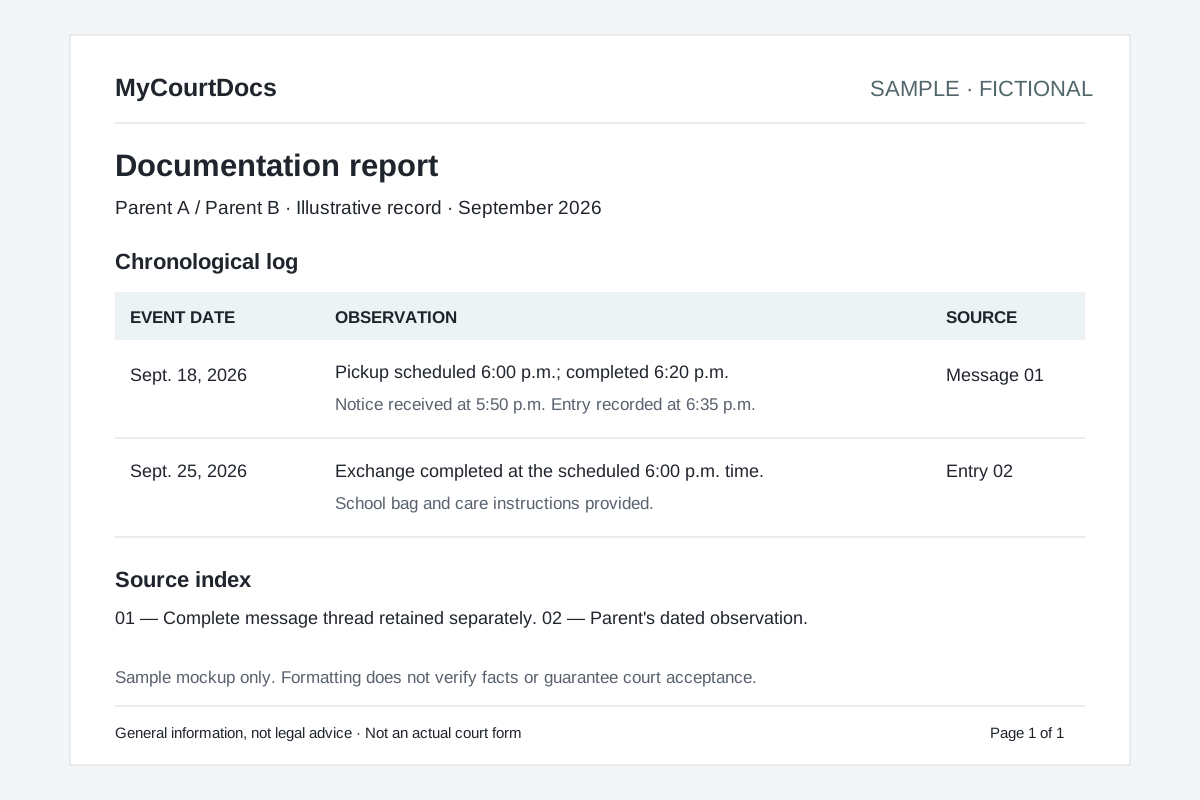
Keep changes and calculations transparent
For an agreed adjustment, retain the original schedule and describe the new arrangement separately. Keep makeup-time requests and completed time distinct. Do not describe requested time as time that already occurred.
If you summarize hours, document your method and use actual start and end times where known. Mark gaps and uncertain times clearly. An overnight count, hour total and scheduled allocation are different measures and should not be mixed.
- Original schedule remains identifiable
- Requested, agreed and completed changes stay separate
- Unknown times are not replaced with assumed values
- Calculations name their method and source entries
Review and share the log carefully
Review the chronology periodically for missing source references and explain corrections. Back up original messages and related files. Use an index to locate supporting material without presenting a brief summary as the entire conversation.
Before sharing a report, review information about children and other people. A log or formatted PDF does not verify facts, determine legal compliance or guarantee a court result. Ask a licensed attorney about relevance, redactions and filing requirements.