Start with the event, not a conclusion
A useful log answers what happened, when it happened, who was involved and how you know. Write what you directly observed. If someone else told you something, identify it as a report rather than a firsthand observation. Do not diagnose a parent, infer intentions or use a log to score disagreements.
Document relevant exchanges, practical communications, schedule changes and child-related care. Include routine on-time exchanges, completed appointments and cooperative arrangements. A balanced record retains context instead of selecting only difficult moments.
- Event date, local time and location
- Scheduled arrangement and what actually occurred
- Observable actions and exact relevant quotations
- Source file reference, witnesses and any uncertainty
Separate observation, quotation and interpretation
Use quotation marks only for words you can accurately reproduce. Retain the full message thread, including your replies and surrounding context. If the exact wording is uncertain, say that you are paraphrasing. A screenshot should not silently replace the original conversation.
For information about a child, describe observable care or an unprompted statement without making a diagnosis. Do not question a child to generate evidence. Record only necessary details and consult a licensed attorney about privacy, recording and disclosure requirements.
Fictional examples: emotional vs. factual entries
All dates, events and parent labels below are fictional. Use the structure, not the invented facts.
Exchange timing
Emotional wording: “Always late and does not care about anyone else's time.”
Factual wording: Fictional example — September 18, 2026: pickup scheduled for 6:00 p.m. at the agreed location. Parent B arrived at 6:20 p.m. A 5:50 p.m. message stated, ‘Running about 20 minutes late.’ Full thread retained as message-01. Entry recorded at 6:35 p.m.
Appointment information
Emotional wording: “Never tells me anything about appointments.”
Factual wording: Fictional example — September 21, 2026: Parent A requested the appointment time by message at 9:10 a.m. Parent B replied at 1:15 p.m. with the clinic and 3:00 p.m. time. Full exchange retained as message-02. No statement is made about intent.
Completed responsibility
Emotional wording: “For once, everything actually went right.”
Factual wording: Fictional example — September 25, 2026: exchange completed at the scheduled 6:00 p.m. time. School bag and medication instructions were provided. No schedule change was requested.
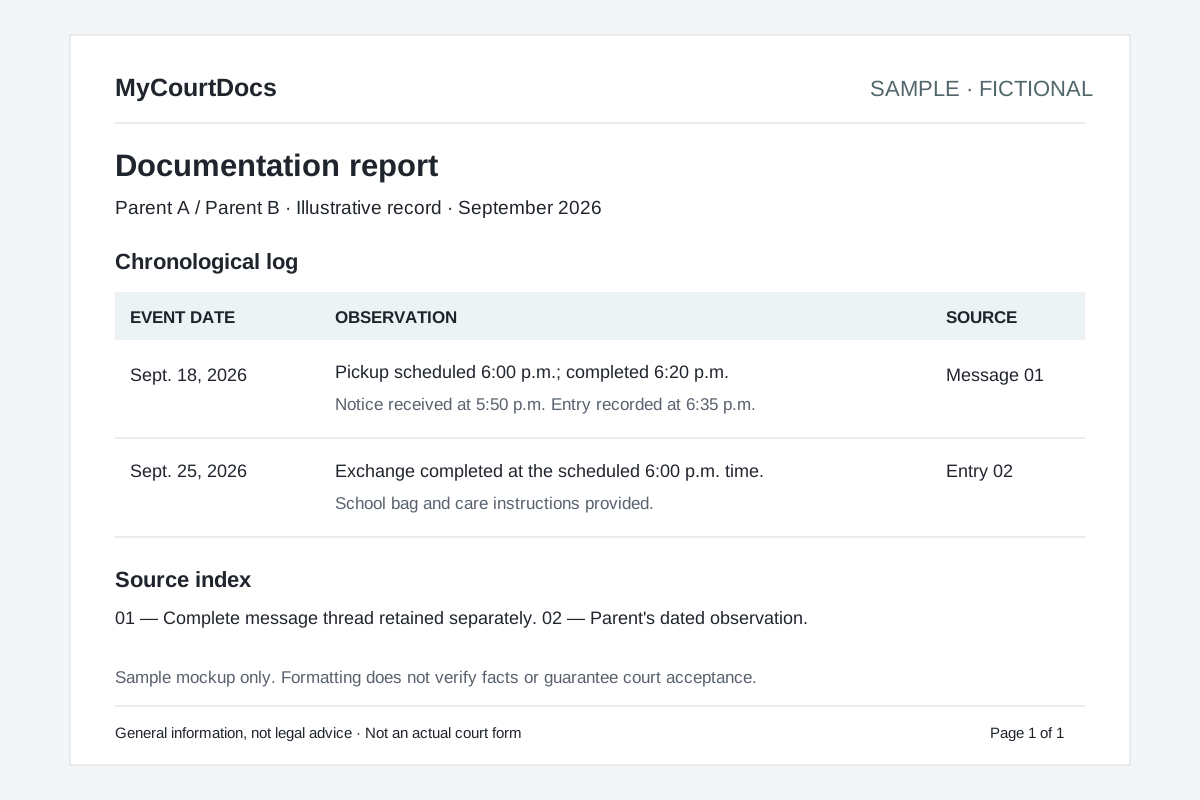
Keep a consistent record over time
Choose a routine that you can maintain: a brief entry near the event, followed by a weekly check for missing dates or file references. A late entry should say both when the event occurred and when you recorded it. Never backdate an entry to make it appear contemporaneous.
If you discover an error, explain the correction and retain the supporting source. Keep separate copies of original messages, receipts, photographs and recordings you are entitled to retain. A timestamp or file fingerprint does not independently establish that a statement is true.
- Include ordinary and concerning events using the same fields
- Record delayed entries honestly
- Explain corrections instead of obscuring them
- Back up originals and restrict access to intended recipients
Prepare material for attorney review
Arrange entries chronologically and connect each relevant source file to its entry. A short index can identify the date, topic and location of each original. Distinguish missing information from a fact you can verify.
A formatted report organizes your records; it does not authenticate evidence, decide a legal issue or guarantee a court result. Ask a licensed attorney which material is relevant and how to handle redactions, disclosure and local filing requirements. Keep original audio and video separately from any printed report.