
Allowed in vs. persuasive: three different questions
People often ask whether a custody journal or app record can be used in court as if that is a single yes-or-no question. In practice, a court looks at three separate questions. First, whether the judge allows the record to be considered at all under the evidence rules that apply in your state. Second, weight — how much the judge trusts and relies on a record once it is considered. Third, sufficiency — whether everything presented together is enough to support what a parent is asking for.
A record can be considered by the court and still carry little weight, for example if entries were written weeks later, use loaded language, or leave out important context. A careful, consistent record is easier for an attorney to work with, but no format, app, or export decides any of these questions for the court.
- Consideration: may the court consider this record under state rules?
- Weight: how much does the court trust and rely on it?
- Sufficiency: is the whole record enough to support the request?
Authentication: someone has to vouch for the record
Before a record is considered, someone generally has to show that it is what it claims to be. For a journal, that is usually the parent who wrote it, explaining when and how entries were made. For text messages, it may involve the phone or account that received them and the complete thread. For photos and videos, it may involve who took them, when, and whether the file was changed.
Original files, complete threads, and saved file details make this easier to explain. A timestamp or file fingerprint can show when something was saved, but it does not prove that a statement inside the record is true. Some records held by a business or platform are introduced through a records custodian; ask your attorney what your court expects for each type of record.
Hearsay in plain terms
Hearsay generally means a statement made outside of court that is offered to prove that what it says is true. The rules include many exceptions, and they vary by state. This page describes general concepts only; it does not decide how any rule applies to your records.
A few general ideas come up often. Statements made by the other parent and offered by you are often treated differently from statements by people who are not part of the case. Your own notes may be used to help refresh your memory while you testify, even if the notes themselves are not entered into evidence. Statements from a child raise separate and sensitive questions. Ask your attorney which rule or exception applies in your state before relying on any record.
What makes a custody journal credible
Courts and attorneys often look at how and when a record was made, not only what it says. A journal that reads like a steady, factual account is easier to rely on than one assembled after the fact or written to make a point.
The habits below help a record speak for itself. They do not guarantee how a court will treat it.
- Write entries the same day, or as soon as you reasonably can
- Record the date written separately from the date of the event
- Describe facts and exact quotes, not conclusions or labels
- Include routine and good days, not only problems
- Make dated corrections instead of silent edits
- Keep complete message threads, not cropped screenshots
- Keep original photos, videos, and files unaltered
Private journal vs. shared co-parenting app records
Messages sent through court-ordered shared co-parenting apps come from the platform both parents use; the platform holds the record of what was sent and when. A private journal is your own account of events, written and stored by you. They answer different questions, and many parents use both.
If a court order requires a shared app, keep using it exactly as ordered and keep your private records alongside it. A private journal may still be requested and reviewed in a case, so write every entry as if a judge will read it.
How MyCourtDocs exports are built for attorney review
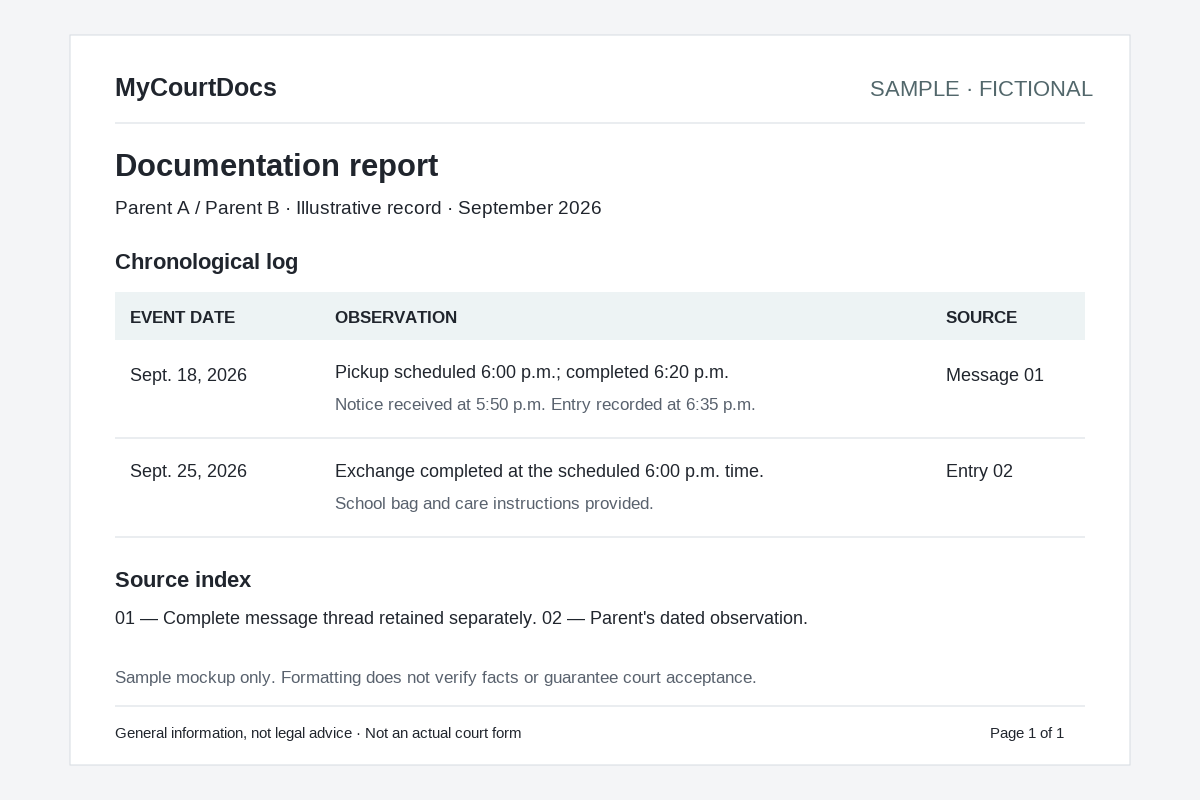
MyCourtDocs timestamps each entry when it is created and lets you record the event date separately. Photos, screenshots, and documents stay attached to the entries they support. Court-format PDF exports include a caption, Bates-numbered pages, an exhibit index, and a declaration for the parent to review and sign.
These exports are designed to make records easier for an attorney to review and organize. They do not authenticate statements, replace original audio, video, or other files, or promise how a court will treat any record. Your attorney decides what to offer and how.
Related: How court-ready exports are organized · Business records affidavits
Before your hearing: a short checklist
Use this list to organize what you already have. It is a preparation aid, not a filing requirement, and your attorney may ask for something different.
- Confirm the current court order and keep following it, including any required shared app
- Arrange entries in date order with the event date and the date written
- Gather original files and complete message threads for anything you mention
- Mark gaps and corrections honestly; do not edit or delete entries now
- Ask your attorney which records to offer, how to authenticate them, and what to redact
- Bring copies in the format and number your attorney recommends